What the specific model does
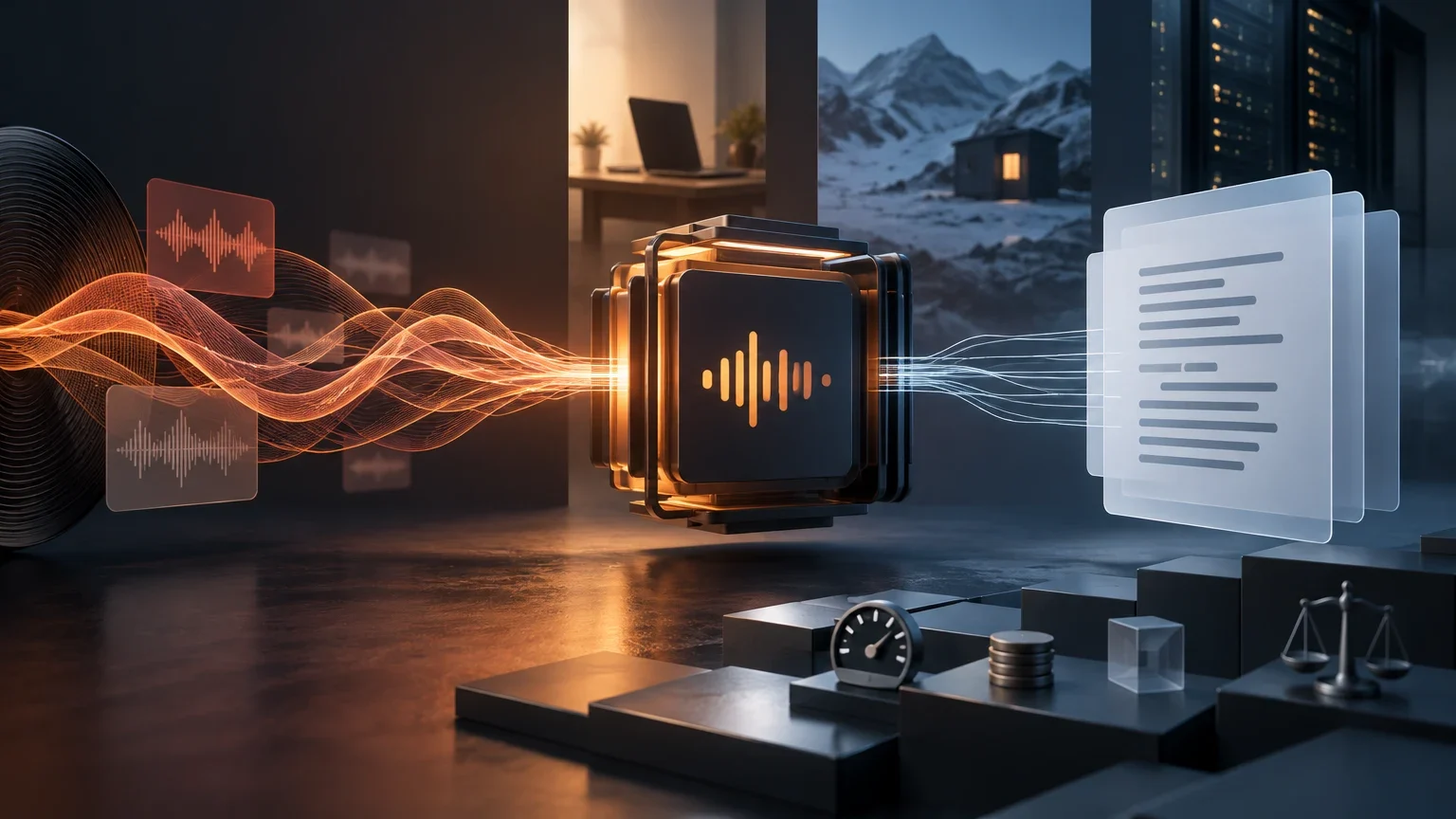
Voxtral Mini Transcribe 3 is a specific variant of the Voxtral family designed for audio-to-text transcription. Unlike the multimodal chat versions, this model focuses on the direct conversion of voice signals into written text, optimizing performance for speech recognition (ASR) tasks without the overhead associated with generating complex conversational responses.
The architecture is based on the Ministral 3B language model, to which an audio encoder based on Whisper large-v3 has been added. This design allows the model to process audio inputs of up to 30 minutes in duration in transcription mode, leveraging a context window of 32,000 tokens. The model operates in a dedicated transcription mode, meaning it does not require additional text prompts to function, simplifying integration into voice processing pipelines.
The reliance on the Whisper large-v3 audio encoder provides a robust foundation for feature extraction, ensuring that the acoustic representations fed into the Ministral 3B language model are of high quality. This hybrid approach leverages the proven capabilities of the encoder in handling diverse acoustic conditions, while the language model component focuses on the linguistic structuring of the output. By separating the audio processing from the text generation logic, the architecture minimizes computational redundancy, allowing the system to maintain efficiency even when processing continuous streams of speech data within the defined 30-minute limit.
The dedicated transcription mode simplifies the integration workflow by removing the need for complex prompt engineering. In standard multimodal setups, users often need to craft specific instructions to guide the model's behavior, which can introduce variability and potential errors. In contrast, the Transcribe variant operates with a fixed objective, converting audio to text directly. This deterministic behavior is particularly advantageous for automated pipelines where consistency and predictability are paramount, reducing the risk of unintended outputs that might arise from ambiguous conversational prompts.
Capabilities and examples by task
The model stands out for its multilingual capability, automatically supporting language detection and transcription in the most widely used languages worldwide, including English, Spanish, French, Portuguese, Hindi, German, Dutch, and Italian. This feature eliminates the need to manually configure the input language, reducing operational complexity in environments with diverse users.
In terms of functionality, Voxtral Mini Transcribe 3 allows for the transcription of long audio, handling files of up to 30 minutes in its standard configuration. Although the general documentation for the Voxtral family mentions capabilities of up to 40 minutes for audio understanding, the transcription variant focuses on the accuracy of the resulting text. The model does not currently support system prompts, which limits advanced customization, but it allows multiple audios per message and multiple user turns with audio in chat configurations, although its primary use is direct transcription.
The automatic language detection feature is particularly valuable in heterogeneous environments where the source audio may not be pre-labeled. By eliminating the manual configuration step, the model reduces the operational overhead associated with managing multiple language streams. This capability ensures that the system can adapt dynamically to the input, providing a seamless experience for users who may switch between languages or process mixed-language content without requiring additional preprocessing steps or metadata annotations.
While the model supports multiple audio inputs per message and multiple user turns in chat configurations, its primary design intent remains focused on direct transcription. This distinction is important for developers who might consider using the model for interactive applications. Although the technical infrastructure allows for such interactions, the lack of system prompt support means that the model cannot be easily customized to handle complex conversational logic or context-dependent responses, reinforcing its role as a specialized transcription tool rather than a general-purpose assistant.
Published benchmarks and methodology
Performance results published by Mistral indicate that Voxtral Mini Transcribe outperforms closed models such as GPT-4o mini Transcribe and Gemini 2.5 Flash in speech recognition tasks. The main metrics used are the word error rate (WER) on datasets such as FLEURS, Mozilla Common Voice, and Multilingual LibriSpeech.
It is important to note that these benchmarks come from the provider (Mistral AI) and have not been independently replicated by third parties at the time of writing this analysis. The evaluation methodology includes the macro-average of WER across multiple languages and tasks, providing an overview of multilingual performance. However, the lack of independent evaluation means that users must validate performance in their own use cases before adopting the model at scale.
The use of the word error rate (WER) as the primary metric provides a standardized way to compare performance across different models and languages. However, WER is a coarse-grained measure that does not capture all aspects of transcription quality, such as punctuation accuracy, capitalization, or the handling of non-speech sounds. Users should be aware that while a lower WER indicates fewer word-level errors, it may not fully reflect the usability of the transcript in downstream applications that require precise formatting or semantic understanding.
The macro-average calculation of WER across multiple languages ensures that the performance of the model is not skewed by its strength in a single dominant language. This methodology provides a more balanced view of the model's multilingual capabilities, highlighting its consistency across the supported languages. Nevertheless, the absence of independent replication of these benchmarks means that the reported figures should be treated as indicative rather than definitive, and users are encouraged to conduct their own evaluations to confirm that the model meets their specific accuracy requirements.
Benchmark comparison (provider data)
Reference table with the WER metrics reported by Mistral for Voxtral Mini Transcribe against competitors. The values are indicative and come from official documentation.
| Model | FLEURS (WER) | Common Voice (WER) | Notes |
|---|---|---|---|
| Voxtral Mini Transcribe | Competitive | Competitive | Outperforms GPT-4o mini Transcribe |
| GPT-4o mini Transcribe | Reference | Reference | Closed model |
| Gemini 2.5 Flash | Reference | Reference | Closed model |
Pricing and deployment requirements
Deploying Voxtral Mini Transcribe 3 requires approximately 9.5 GB of GPU memory in bf16 or fp16 format. This makes it viable for deployments on edge hardware or servers with mid-range GPUs, such as NVIDIA A10 or T4, depending on the workload and required latency.
Regarding pricing, the Transcribe variant is not available for weight download, so its use is limited to hosted services or third-party APIs. On Amazon Bedrock, the model is available under the ID 'mistral.voxtral-mini-3b-2507', with pricing based on token or audio minute consumption, depending on the service configuration. Users must consult the Bedrock pricing page for current figures, as they may vary by region and service tier (Standard, Priority, Flex).
The requirement of approximately 9.5 GB of GPU memory in bf16 or fp16 format positions the model as a viable option for edge computing scenarios. This memory footprint is relatively modest compared to larger language models, making it suitable for deployment on hardware with mid-range GPUs. This characteristic is particularly relevant for organizations that need to process audio data locally to minimize latency or to comply with data residency requirements, although the specific Transcribe variant's restriction to hosted services may limit this flexibility for certain use cases.
The pricing model on Amazon Bedrock, which is based on token or audio minute consumption, offers a predictable cost structure for users who prefer a pay-as-you-go approach. This model aligns with the variable nature of audio processing workloads, where the volume of data processed can fluctuate significantly. Users should monitor their consumption patterns to optimize costs, especially when processing large volumes of audio data, and consider the trade-offs between using hosted services and deploying open-weight alternatives that may require higher upfront infrastructure investments.
Deployment process in vLLM
Steps to deploy a compatible variant of the Voxtral family locally (note: the specific Transcribe variant may require access to a hosted API, but the architecture is similar).
- 01Install vLLM with audio support: uv pip install -U "vllm[audio]" --system
- 02Verify the installation of mistral_common: python -c "import mistral_common; print(mistral_common.__version__)"
- 03Start the server: vllm serve mistralai/Voxtral-Mini-3B-2507 --tokenizer_mode mistral --config_format mistral --load_format mistral
- 04Configure the client to point to the local or remote endpoint
Limitations, security, and alternatives
A significant limitation is the lack of support for system prompts, which restricts the ability to customize the model's behavior through contextual instructions. Additionally, the available timestamps are at the segment level, not the word level, which may be insufficient for applications requiring fine temporal precision, such as automatic subtitle synchronization.
In terms of security, as a transcription model, the audio data sent to the service must comply with applicable privacy regulations (GDPR, CCPA, etc.). Since the Transcribe variant does not allow local deployment with downloadable weights, audio data must be transmitted to a remote server, which implies considerations for data residency and encryption in transit. Alternatives such as Whisper large-v3 offer open weights for local deployment, although with potentially inferior performance in certain languages or specific contexts.
The limitation of segment-level timestamps, rather than word-level, imposes constraints on applications that require precise temporal alignment. For example, in the creation of interactive subtitles or karaoke-style applications, the lack of word-level timing information may necessitate additional post-processing steps to estimate the timing of individual words. This can introduce complexity and potential inaccuracies, particularly in cases where the speech rate varies significantly or where there are pauses and overlaps in the audio.
The security implications of transmitting audio data to a remote server are significant, especially in regulated industries. The need to comply with privacy regulations such as GDPR and CCPA requires careful consideration of data handling practices, including encryption in transit and at rest. Organizations must ensure that their data processing agreements with the service provider include adequate safeguards to protect sensitive information and that the data residency requirements of their jurisdiction are met.
Practical selection criteria
The decision to use Voxtral Mini Transcribe 3 should be based on the balance between accuracy, cost, latency, and privacy requirements. If the priority is maximum accuracy in multilingual transcription and cloud deployment is acceptable, this model is a solid option. If privacy is critical and full control over data is required, alternatives with open weights such as Whisper or local versions of Voxtral (if available for the specific variant) might be more suitable.
For teams that need to integrate transcription into existing workflows, compatibility with vLLM and the OpenAI API facilitates adoption. However, the lack of support for system prompts and the limitation of segment-level timestamps should be considered when designing the solution architecture. It is recommended to conduct pilot tests with proprietary data to validate performance before production implementation.
The decision to adopt Voxtral Mini Transcribe 3 should be informed by a thorough assessment of the trade-offs between accuracy, cost, and privacy. While the model offers high multilingual accuracy and ease of integration, the lack of local deployment options and system prompt support may be prohibitive for certain use cases. Teams should evaluate their specific requirements and consider conducting pilot tests with representative data to validate the model's performance and ensure that it meets their operational needs before committing to a full-scale implementation.
For organizations that prioritize data control and privacy, the availability of open-weight alternatives such as Whisper large-v3 provides a viable option for local deployment. However, these alternatives may require more significant infrastructure investments and may not offer the same level of multilingual accuracy or ease of use. The choice between these options should be guided by a careful analysis of the total cost of ownership, including infrastructure, maintenance, and potential performance differences, to determine the most suitable solution for the organization's specific context.
Decision table: When to use Voxtral Mini Transcribe 3?
Criteria to evaluate the suitability of the model in different scenarios.
| Criterion | Voxtral Mini Transcribe 3 | Whisper large-v3 | GPT-4o mini Transcribe |
|---|---|---|---|
| Local deployment | No (hosted API) | Yes (open weights) | No (closed API) |
| Multilingual accuracy | High | High | High |
| System prompt support | No | No | Yes |
| Infrastructure cost | Moderate (9.5GB GPU) | Variable (depending on hardware) | Low (pay-per-use) |
Open questions
- Specific API pricing for Voxtral Mini Transcribe 3 from Mistral is not confirmed in the sources read; the Bedrock pricing page or the provider must be consulted.
- The availability of the Transcribe variant on other inference platforms besides Amazon Bedrock is not verified.
- Exact performance in less frequent languages or with regional accents is not detailed in the public benchmarks.
- The exact release date of the Transcribe 3 variant is not clearly differentiated from the general Voxtral family in all sources.
Keep exploring
Sources consulted
Corrections and transparency
If you spot incorrect or outdated information, send us a correction with the page and source we should review.
Submit a correction