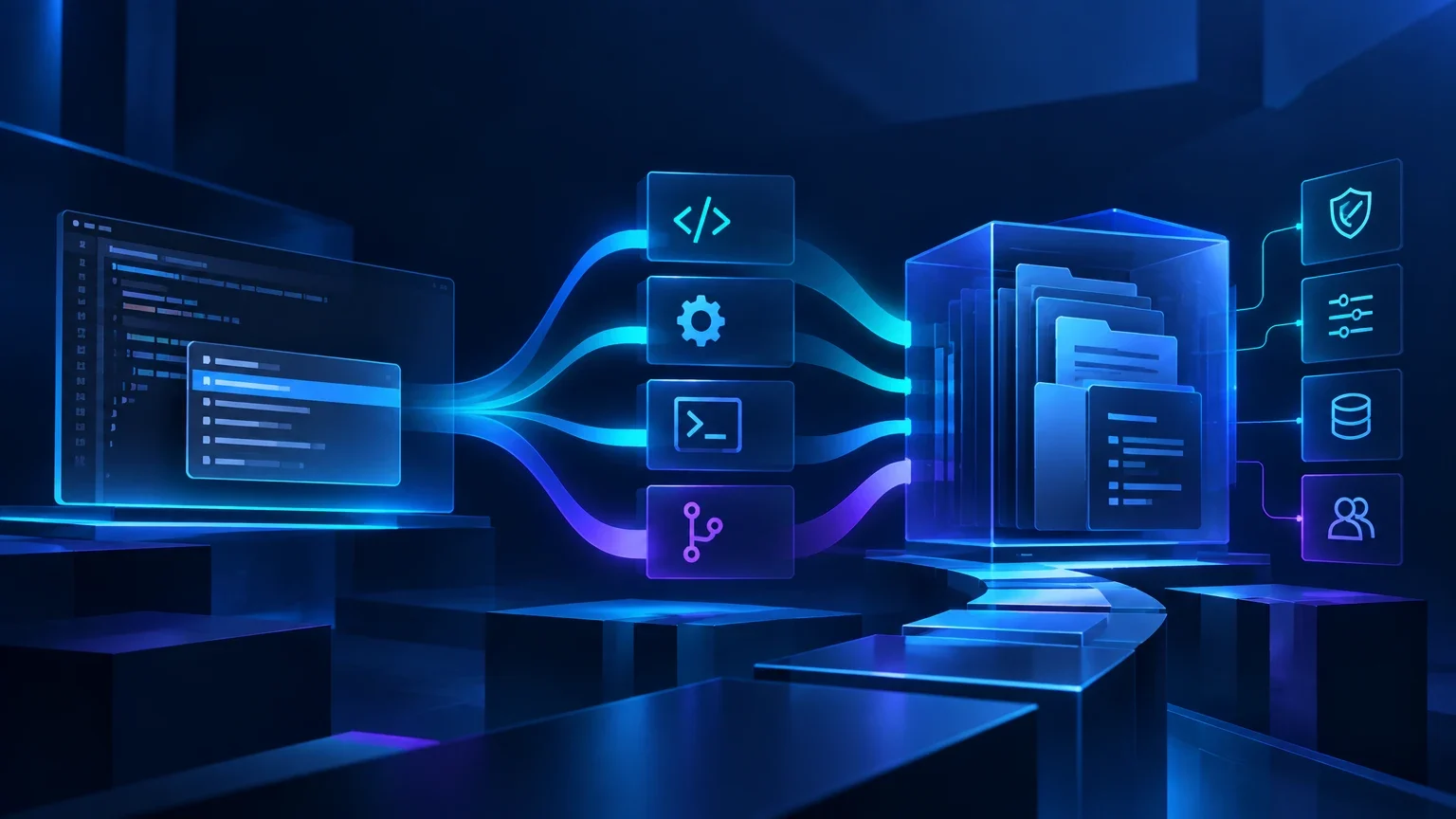
The decision is not about choosing “the best AI,” but about defining work and an access level
A coding assistant may be a point-in-time aid inside the editor, a conversation that consults files, a system that comments on changes in a pull request, or an agent that modifies a repository and runs tools. These categories share some underlying technology, but they do not share the same operational risk. Asking for an explanation of a function is not equivalent to granting write access to a branch, command execution, or network access.
The purchasing or deployment question should be reframed: which specific task does the team want to accelerate, what evidence will it accept before integrating a change, and which actions may the tool perform without intervention? The model is one component of the answer, not the whole answer. Integration with the development environment, the authentication mechanism, the data policy, permission boundaries, activity logging, and the ability to revert results also matter.
GitHub documentation distinguishes among inline suggestions, chat, editing, review, and agent modes. It also documents a cloud agent that can receive an issue, explore a repository, propose changes, and create a pull request. That fact describes a product capability; it does not demonstrate that the output is correct, secure, or appropriate for every codebase. Acceptance remains an engineering decision.
As a navigation starting point, this guide should connect to “AI tools: guides for choosing by task.” To move from general comparison to a maintenance scenario, follow the “decision path for maintaining repositories.” Both paths help prevent a short demonstration from becoming, without evaluation, authorization to operate on relevant systems.
Task map: useful capability depends on the kind of work
Autocomplete helps reduce friction when writing repetitive or predictable code. Its output is usually small, immediately visible, and easy to discard. It is a reasonable category when the objective is to speed up local editing and human review is already part of the normal workflow. It should not be evaluated using the same metric as a tool that attempts to resolve complete issues.
A chat tool with repository context can help locate implementations, explain dependencies, summarize an architecture, or propose tests. Its value depends on which files it can retrieve, whether it correctly identifies the relevant version of the code, and whether it communicates uncertainty when it lacks sufficient context. Retrieving information from the repository may improve coverage, but it does not remove the need to check references, assumptions, and behavior at runtime.
Automated review sits between those two cases. It may flag inconsistencies, suggest tests, or identify patterns that deserve attention, but its comments must enter the same prioritization process as comments from any reviewer. A comment is not a confirmed defect; nor does the absence of comments prove that a change is safe.
Issue fixing and maintenance through agents are another class of work. Here, the system may search files, edit several components, run tests or linters, and prepare a pull request. The range of actions increases, but so does the cost of a bad assumption: it may modify unintended code, consume resources, misinterpret an instruction, or propose a solution that exceeds the issue’s scope. The expression “what it means for an assistant to act as an agent” should lead to a definition that separates autonomy from reliability.
Relationship between task, evidence, and initial permissions
| Task | Expected output | Recommended initial permission | Evidence before acceptance |
|---|---|---|---|
| Autocomplete | Editable snippet in the local environment | Read access to the active file or minimal context | Build, relevant tests, and human review |
| Explanation or navigation | Answer with file references and assumptions | Limited repository read access | Verification of paths, versions, and technical claims |
| Change review | Comments or a proposed correction | Read access to the change and needed context | Triangulation among comment, requirement, and test |
| Issue fixing | Proposed branch or pull request | Isolated write access and approved execution | Tests, security review, and integration approval |
| Maintenance with tools | Changes and command results | Explicit permissions by action and isolation | Complete log, possible rollback, and result review |
Four solution categories and their trade-offs
An assistant integrated into an IDE favors short interactions: completing, transforming, explaining a selection, or generating a draft. It normally has a limited radius of action, although its actual conditions depend on product and account configuration. It is suitable for teams that want to preserve a local editing workflow and first measure adoption, acceptance, and introduced defects.
Chat with repository context is useful for research and orientation. It may add more value in extensive codebases than autocomplete because it reduces search time and makes it easier to ask questions about relationships among modules. In exchange, it requires examining how content is indexed, how much context is retrieved, what happens with private repositories, and whether the response distinguishes retrieved facts from inferences.
Review automation operates on changes that have already been prepared. Its advantage is that it can be inserted before approval, where diffs, owners, and traceability exist. Its trade-off is noise: if it produces too many irrelevant alerts, reviewers will learn to ignore it. The pilot should measure practical precision and review time, not only the number of observations generated.
An agent with tool access can move through the cycle of investigating, modifying, and validating. GitHub documents agent modes that can run tests or linters and work with changes; it also documents a cloud agent that can create pull requests from issues. Anthropic documents permission controls for its command-line tool and warns that the mode that skips permission prompts is dangerous. The general lesson is not that one category is inherently better, but that autonomy must be matched to an isolated environment and verifiable consequences.
Selection matrix: turn constraints into an operational decision
Code sensitivity is the first filter. A repository containing credentials, personal information, production infrastructure, or regulated logic needs precise knowledge of what content is transmitted, who processes it, how long it is retained, and which administrative controls exist. Codex enterprise administration documentation describes enterprise controls related to code connection, task automation, data residency, retention, and the use of organizational data for training. That does not replace contractual review, security review, and review of each organization’s specific configuration.
The second filter is the radius of action. Reading, writing, command execution, network access, and pull-request creation are qualitatively different permissions. They should be granted independently whenever the tool allows it. GitHub’s documentation on agents identifies controls relating to repository and branch scope, Actions secrets, workflow approval, protection against exfiltration, and logs. These functions must be verified in the plan and configuration that will actually be used, not assumed merely because the tool exists.
The third filter is the supervision available. A team with expert reviewers, fast tests, and ephemeral environments can trial proposed changes more safely than a team without test coverage or the ability to reproduce incidents. When there is no reliable way to validate the result, expanding autonomy does not solve the problem: it shifts it to integration, operations, and incident response.
There are also less visible technical factors: language and build tooling, repository size, monorepo versus small repositories, required connectivity, private dependencies, and the time needed to prepare context. None of them alone allows the outcome of an agent to be inferred; all must be included in a representative test.
Initial decision matrix
| Dominant condition | Category to test first | Recommended boundary | Criterion for progressing |
|---|---|---|---|
| Sensitive code or strict data requirements | Local assistant or restricted-read tool | No secrets, no network, and no initial writing | Validate data handling and usefulness with non-critical tasks |
| Repetitive technical debt and strong tests | Agent in an ephemeral environment | Isolated branch, permitted commands, and mandatory review | Small changes that pass tests and are accepted with little rework |
| Slow reviews due to change volume | Review automation | Access to the diff and limited context | Actionable comments without disproportionately increasing noise |
| Architecture that is difficult to navigate | Chat with controlled retrieval | Read-only access and identifiable sources | Verifiable answers that save search time without inventing relationships |
| No tests or available review | No write automation | Explanation or drafting help only | First build validation and rollback capability |
Design a pilot that measures accepted changes, not impressions
A useful pilot uses issues, maintenance changes, and reviews that resemble ordinary work. The set should include easy and difficult tasks, components with different dependencies, and cases in which the tool should not act. Excluding failures or selecting only problems prepared for a demonstration biases the result.
Before starting, define a baseline. Record time to a reviewable proposal, human review time, number of iterations, tests run, defects detected after integration, attributable spending, and permission blocks. Then compare against the existing process for equivalent tasks. Time saved while writing may not offset slower review or a higher rate of regressions.
The acceptance rate must be interpreted carefully. A high acceptance rate may indicate usefulness, but it may also mean that the team chooses trivial tasks. A low acceptance rate may reveal irrelevant responses, poor integration, or overly ambitious selection criteria. It is therefore useful to classify rejections: misunderstanding, insufficient context, test failure, out-of-scope change, security risk, excessive cost, or inability to run a needed tool.
Context consumption deserves its own metric. If a task requires repeating instructions, uploading files, or manually reconstructing dependencies, the assumed saving may disappear. Also record denied actions and permission requests: they show whether the policy is too restrictive for the use case or whether the use case requires privileges the team is unwilling to grant.
Pilot process with stopping conditions
- 01Select a frozen set of representative tasks and define what counts as success, rejection, and harm.
- 02Configure an isolated environment, with no secrets available by default, minimum permissions, and a record of every action.
- 03Run read, explanation, or proposal tasks first; enable writing only for authorized tasks and branches.
- 04Review outcomes using the same technical criteria applied to human contributions.
- 05Measure time, cost, test coverage, iterations, regressions, blocked actions, and administration effort.
- 06Stop or reduce the pilot in the event of exfiltration, unauthorized execution, repeated out-of-scope changes, serious regressions, or inability to audit actions.
- 07Expand scope only if results hold across more than one component and under independent review.
How to read SWE-Bench and Terminal-Bench without turning a public result into a guarantee
Public evaluations help formulate questions; they do not replace a pilot. SWE-bench was designed from issues and pull requests in real repositories; the original work describes a set of problems from Python projects. Its proximity to issue resolution may make it more informative than an isolated generation test, but it does not automatically represent the languages, dependencies, integration policies, or constraints of a particular repository.
To interpret a SWE-Bench result, identify the evaluated variant, cutoff date, task subset, protocol, number of attempts, environment, and validation criterion. It also matters to know which tools the agent was allowed to use, its compute budget, and whether the result comes from a reproducible run. The guide “what SWE-Bench measures and why it is not enough to predict performance in your repository” should expand on these differences before percentages are compared across providers.
Terminal-Bench evaluates agents on command-line interface tasks, and its publication describes realistic tasks, an execution environment, and an evaluation harness. This provides information about the ability to operate through commands under a specific protocol. However, good terminal performance does not prove that a tool understands an organization’s deployment rules, threat model, or review conventions. The entry “evaluation of terminal tasks and limits of comparability” should explain which parameters make two results comparable.
The correct analysis separates three questions: whether the system completed the benchmark task; whether it could do so within a comparable configuration; and whether benchmark conditions resemble real work. The last question cannot be answered with a public table. It is answered with controlled internal tasks, observability, and security criteria.
Minimum operational security for tools that change code or run commands
The permission policy should describe actions, not just products. Repository reading, file writing, test execution, dependency installation, network access, access to internal services, branch creation, and pull-request opening require differentiated controls. A tool that can run commands may affect the file system, compute time, and services reachable from the environment, even when its stated objective is to fix an issue.
Isolation is a central barrier. Use ephemeral environments or sandboxes, resource limits, defined working directories, and a restricted network where the use case permits it. GitHub documents that its CLI can be configured to work autonomously and that limited permissions reject actions requiring approval; it also presents local or cloud sandboxing as an isolation measure. Autonomous configuration should not be understood as an automatic recommendation for production.
Secrets require specific treatment. They should not be available by default to tasks that do not need them. GitHub’s documentation on agents indicates that there is no default access to Actions secrets and describes controls for workflows, traceability, and logs. Before enabling any integration, the team must verify the exact behavior of its environment, including external providers, logs, and connectors.
Every action with an external effect needs traceability: received instructions, supplied context, proposed and executed commands, modified files, test results, approvals, and the integration owner. For the detailed policy, link to “controls for tools that write code, run commands, or open pull requests.” Rollback must also be ready before the pilot: isolated branches, small changes, retained artifacts, and clear procedures for undoing an integration.
Authorization sequence by action
- 01Allow read access only to the repository and branch declared for the task.
- 02Require explicit approval to write outside the intended work area.
- 03Restrict commands to a list or controlled environment; record output and exit code.
- 04Block secrets and network access unless there is documented justification and specific controls.
- 05Require human approval before opening or updating a pull request and before integrating changes.
- 06Keep a reviewable record and a way to revert every proposed change.
Total cost, disqualification signals, and a decision template
Total cost of ownership is not limited to a license, subscription, or consumption units. It includes execution infrastructure, identity administration, context preparation, integration maintenance, review time, training, incident investigation, and the cost of erroneous changes. For an agent, cost per resolved issue must include failed attempts and human review, not only tasks that ended in an apparently correct proposal.
There are sufficient signals to stop an evaluation before it ends. They include opacity about data handling, inability to limit permissions, incomplete logs, benchmark results without reproducible configuration, dependence on a non-exportable workflow, inability to isolate execution, and pressure to enable secrets or network access without justification. No tool removes the responsibility of the team that authorizes its actions.
Nor is it appropriate to assume capabilities from model names. This material did not provide verified sources demonstrating the availability or integration of GPT-6 Astra, Claude Opus 5, or Gemini 3.8 Flash in specific coding products. Therefore, this guide does not present them as functionally equivalent alternatives. Their published titles should be linked only when verifiable official documentation exists about that availability or integration.
The final decision should be brief and auditable: selected category, authorized tasks, included repositories and branches, permitted data, permissions, environment, approval owners, metrics, budget, and stopping criteria. If that template cannot be completed, the organization has not yet made an operational decision; it has only expressed interest in a technology.
Final decision template
| Element | Decision that must be recorded |
|---|---|
| Initial use case | Specific task, included components, and exclusions |
| Category | IDE, repository chat, automated review, or agent with tools |
| Data and context | Authorized content, required handling, and exclusions |
| Permissions | Read, write, commands, network, pull requests, and approvals |
| Environment | Isolation, resource limits, secrets, and connectivity |
| Validation | Required tests, responsible reviewer, and acceptance criterion |
| Metrics | Time, cost, acceptance, defects, regressions, and permission blocks |
| Stopping | Events that require suspension, investigation, or scope reduction |
Conclusion: automate only after you can verify
Prudent adoption starts with a small, repeatable, and verifiable task. For autocomplete or explanation, risk may be bounded to individual work. For review, the question is whether comments improve the process without adding noise. For agents, the assessment must include permissions, isolation, tests, logs, and rollback from the outset.
An assistant may reduce search time, speed up drafts, or prepare changes that a team turns into an acceptable solution. None of those benefits authorizes confusing a proposal with reliable autonomous maintenance. The practical difference lies in the controls and in the evidence gathered during a reproducible pilot.
The best decision may be to adopt a limited category, gradually expand another one, or not automate yet. The last option is reasonable when tests, review, traceability, or data clarity are missing. The purpose of evaluation is not to justify a purchase, but to decide which level of automation improves work without degrading security or the ability to retain control.
Open questions
- Capabilities, controls, data terms, and available plans may vary by product, account, region, and configuration; they must be confirmed before deployment.
- Benchmark results do not allow direct inference of performance, cost, or security in a specific private repository.
- No verified sources were provided about the availability or integration of GPT-6 Astra, Claude Opus 5, or Gemini 3.8 Flash in coding tools.
- Product documentation supports each provider’s declared functionality and controls, but it does not replace independent testing or security review of the effective configuration.
Keep exploring
Sources consulted
Corrections and transparency
If you spot incorrect or outdated information, send us a correction with the page and source we should review.
Submit a correction