The proposal: models that can change their own structure
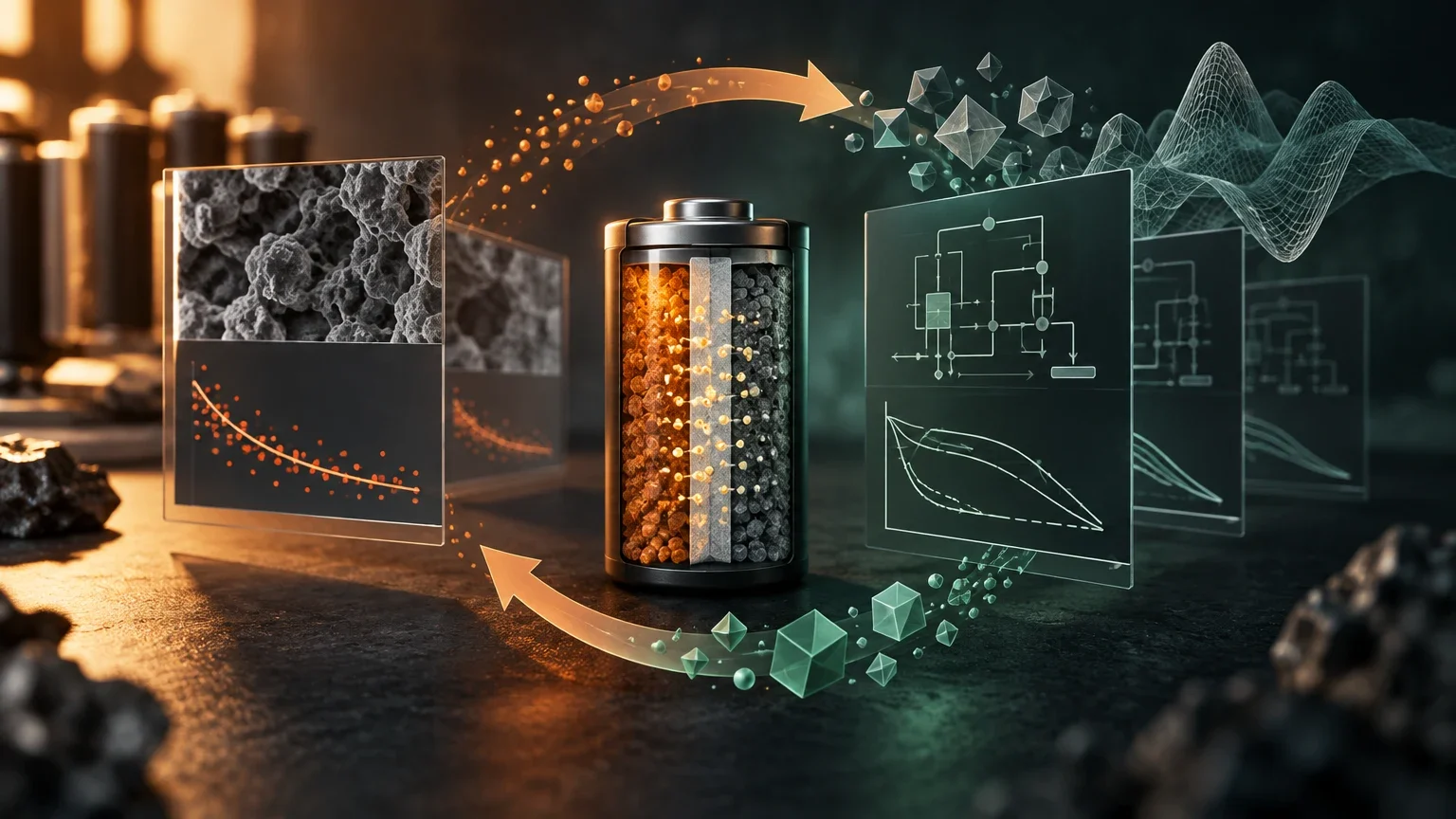
EvoSim is an artificial-intelligence system for physical modeling. According to the abstract of a preprint posted on arXiv, it aims to revise a model’s structure when its predictions do not match experimental results. This goes beyond tuning parameters: building a physical model also involves choosing which processes to represent, defining its states and equations, and specifying how its components interact.
The abstract presents this capability as a response to what it describes as a limitation of existing AI systems: their difficulty in making model-structure decisions autonomously. EvoSim is described as using experimental discrepancies to guide changes to mechanisms and equations, then using held-out experimental data to test physical plausibility. The available record summarizes the proposal but does not provide enough detail to reconstruct how each decision is made.
How discrepancies guide proposed revisions
The central mechanism described starts with a difference between a model’s prediction and an experimental observation. EvoSim is said to use that discrepancy as a signal to revise either the physical mechanism represented or the equations used to express it. In principle, this allows structural changes rather than merely adjusting numerical values within a fixed model structure.
The abstract also says that EvoSim records exploration traces and updates knowledge, skills, and multi-agent coordination. This frames the process as more than making a prediction and then tuning it: the authors claim that experience gained through exploration helps improve both the model and the system’s ability to select mechanisms, diagnose failures, and coordinate research. Without the full methodological account, it is not possible to specify how alternatives are generated or what controls govern each revision.
Revision cycle described in the abstract
- 01Compare a model prediction with an experimental observation.
- 02Use the discrepancy to guide a revision to mechanisms or equations.
- 03Check physical plausibility using held-out experimental data.
- 04Retain exploration traces that, according to the abstract, update knowledge, skills, and coordination.
Two battery tasks, with different metrics
The evaluation reported in the abstract is limited to two industrial battery-modeling tasks. The first predicts the onset of lithium metal plating across a temperature range of 25 to 45 °C and a range of 2 C to 6 C. For this task, the abstract reports a mean absolute error of 1.79% in state of charge.
The second task predicts dynamic voltage under vehicle-driving conditions. The abstract reports a root mean square error of 7.62 mV and says this surpasses the reported accuracy of models developed by human experts. It also states that self-evolution reduces model and physics errors by approximately 36% relative to a baseline. The available extract does not define that baseline precisely, give dataset sizes, or provide the details needed to compare these figures with other studies.
Results reported in the abstract
| Task | Conditions stated | Reported metric |
|---|---|---|
| Predicting the onset of lithium metal plating | 25–45 °C; 2 C–6 C | Mean absolute error of 1.79% in state of charge |
| Dynamic voltage prediction | Vehicle-driving conditions | Root mean square error of 7.62 mV |
| Effect of self-evolution | Comparison with a baseline | Approximately 36% reduction in model and physics errors |
What held-out data can—and cannot—establish
Using held-out data to test plausibility matters because, at least in principle, it distinguishes data used to propose or tune changes from data used to evaluate them. The abstract says EvoSim performs this check with experimental data not used during revision.
However, the extract does not explain how the data were split, whether the split was made by experiment, operating condition, or sample, or whether decisions made during exploration could have influenced which cases were evaluated. It also gives no sample sizes, metric uncertainties, or breakdowns of the results. The mention of held-out data alone is therefore not enough to determine how robust the evaluation protocol is or to rule out information leakage between development and test data.
Limitations and open questions
The arXiv record identifies the work as a preprint submitted on 8 October 2026 and lists six authors. The information provided does not say that it has been peer-reviewed. The abstract gives the main tasks and metrics reported by the authors, but it cannot replace an examination of the paper’s methods, full results, and limitations.
The available evidence also does not establish whether code, data, and exploration traces are available, or whether the authors conducted controlled comparisons with existing methods or ablation studies to isolate the contribution of each component. The claim that EvoSim surpasses the reported accuracy of expert-developed models should be understood as a comparison made by the authors; the extract does not provide enough detail to verify that the models were evaluated under equivalent conditions.
What is needed to assess its usefulness
Assessing the scope of the work requires consulting the full paper and checking its experimental protocol: how baselines are defined, how data are split, what metrics are reported for each condition, what uncertainties are measured, and how the system compares with alternative methods. It would also be important to establish whether the authors provide code, data, and traces sufficient to reproduce the construction and evaluation of each model.
The key question is not only whether EvoSim achieves low errors in these experiments, but whether its revisions are traceable, physically justified, and stable as experimental conditions change. Until those details and independent evaluations are available, the most precise description is that the authors evaluated a proposal on two industrial battery tasks—not that they have validated an autonomous scientist for physical modeling in general.
Useful checks when interpreting the work
- 01Consult the full paper for details of the architecture and revision procedure.
- 02Check how data were held out and whether safeguards against information leakage were used.
- 03Verify comparisons with existing methods and any ablation experiments.
- 04Look for code, data, and traces that would allow the results to be reproduced.
- 05Keep the authors’ reported results distinct from any subsequent independent validation.
Open questions
- The extract does not detail exactly how development data were separated from held-out data, or give sample sizes.
- The evidence provided does not establish whether code, data, and exploration traces have been published.
- The abstract does not allow verification of the conditions used to compare EvoSim with expert-developed models, or reveal the results of any ablation studies.
- The source provided does not document peer review or independent replication.
Keep exploring
Sources consulted
Corrections and transparency
If you spot incorrect or outdated information, send us a correction with the page and source we should review.
Submit a correction