A specific achievement, not proof of general autonomy
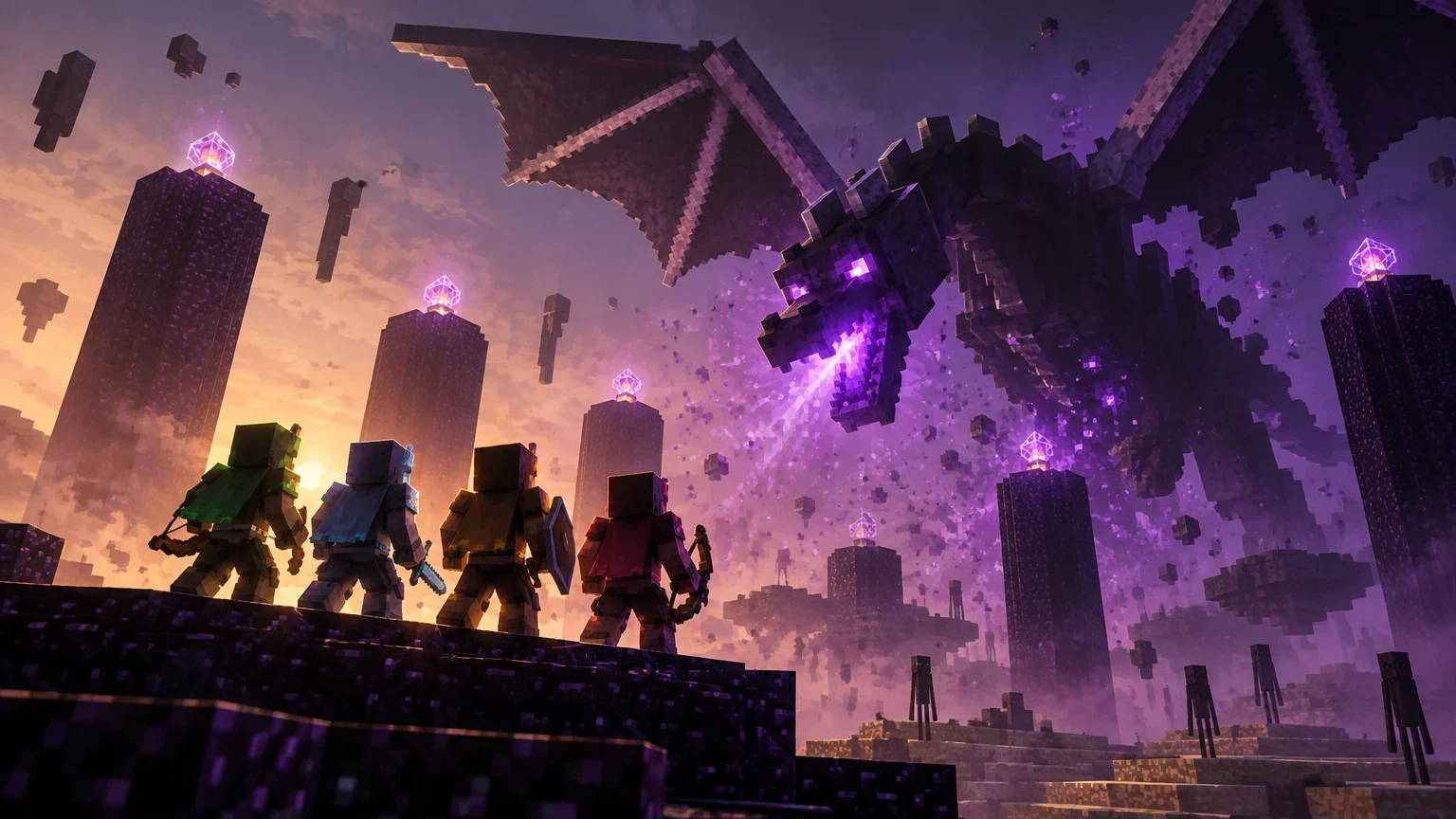
Four agents powered by Gemini 4 Argon defeated Minecraft’s Ender Dragon in a survival game, according to a preprint by Google DeepMind researchers. The run lasted 27 hours and 14 minutes. During that time, the agents wrote 2,783 programs, and their characters died 605 times before completing the goal.
The experiment is notable for combining long-horizon planning, iterative programming, and coordination among agents for more than a day. But its scope is specific: it took place in a randomly generated Minecraft world, on Easy difficulty, inside a sandboxed environment. One successful run cannot, by itself, show that the system can reliably handle business or real-world tasks.
How the agents coordinated
Each agent controlled a player through Mineflayer, an open-source library for interacting with Minecraft. The agents coordinated through in-game chat and shared memory. The study’s summary says that no one assigned them roles or wrote game-specific logic in advance: the agents planned, programmed, and debugged their own programs.
The team divided tasks and shared what it learned. It also recovered items lost by teammates—an important detail in a game where dying can cost resources needed to make progress. This supports describing operational coordination observed during the run, but it does not show that the agents devised an optimal strategy or that their organization emerged without any prepared infrastructure: the researchers had set up the environment, library, and communication mechanisms.
Writing code, failing, and trying again
The figure of 2,783 refers to programs written during the game, while the 605 deaths capture accumulated failures and risks in play. Together, these measures show that the result was not a clean sequence of instructions that worked on the first try. The team had to maintain its overall goal while producing and debugging code to make progress through interdependent stages.
The duration also needs context. The 27 hours and 14 minutes measure the reported run, not necessarily the researchers’ preparation time or the total cost of setting up the experiment. The primary source provided here does not specify the number of accelerators, the hardware configuration, or an economic cost. It is therefore not possible to responsibly calculate the computational cost from these figures.
How to interpret the reported metrics
| Metric | Reported figure | Cautious interpretation |
|---|---|---|
| Agents | 4 | The team size in this run; it does not establish the optimal number. |
| Duration | 27 h 14 min | Time to complete the goal in the reported game. |
| Programs written | 2,783 | Evidence of iterative programming activity; not 2,783 successful solutions. |
| Deaths | 605 | In-game failures; not a success rate that can be compared on its own. |
The claim that there was no human intervention
The researchers say they could watch the game through a live dashboard and pause or stop it, but had no reason to intervene. This account supports the claim that the agents played through the reported run without human intervention, while oversight remained available.
That wording does not mean the experiment involved no human input at every stage. People chose the goal, set up the sandboxed environment, configured the agents, and enabled Mineflayer, chat, and shared memory. Nor does the documentation available here provide an independent audit of the run. The most precise conclusion is that the paper reports a run without active intervention, within a setup created and supervised by researchers.
How to interpret autonomy in this experiment
- 01Separate setup from execution: people configured the environment and tools before the run began.
- 02Clarify the oversight: researchers could observe and stop the game, although they say they did not intervene.
- 03Keep the conclusion narrow: the reported absence of active intervention applies to this run, not to every task or deployment.
What this adds to research on collaborative agents
The technical interest lies in the duration of the task and the dependencies between steps: the agents had to maintain a useful plan, turn it into actions and code, share information, and recover from setbacks. Minecraft provides an interactive environment in which those abilities can be observed against a clear end goal. The experiment is a demonstration of several capabilities working together, not a broad performance evaluation.
The authors connect this kind of challenge to complex software engineering and business tasks, which can also require long-horizon planning and coordination. That connection is a claim about potential relevance, not evidence that the result transfers directly. Real-world environments have different requirements, risks, data, and success criteria. Specific evaluations would be needed to establish whether the agents generalize, and how reliably.
Limitations and open questions
The cited document is version 1 of a preprint posted to arXiv on October 15, 2026. It is a research paper by its authors, but the information provided does not establish that it has been peer-reviewed or independently replicated. The claim that this was the first end-to-end autonomous completion is presented by the authors themselves—with the qualification “to our knowledge”—and should retain that scope.
Assessing reliability would require multiple runs under comparable conditions: for example, different worlds, difficulty levels, and records of failures and completions. It would also help to know the cost of the models and computing resources, how each agent performed, and what effect shared memory had. Without these data, it is not possible to establish a success rate or determine the cost of the experiment.
What is missing for a robust comparison
| Question | Data needed | Why it matters |
|---|---|---|
| How often do they succeed? | Results from multiple runs and conditions | One successful game does not measure a success rate. |
| What does it cost? | Model usage, computing resources, and applicable rates | Run time alone does not determine cost. |
| How general is the capability? | Tests across other worlds, tasks, and difficulty levels | This helps distinguish a specific demonstration from a transferable capability. |
| Can the result be reproduced? | Independent replications using clear protocols | This helps assess robustness and possible dependence on the setup. |
Open questions
- The verified evidence does not specify the hardware, computing resources, or total economic cost.
- It provides neither a success rate across multiple runs nor a comparison with other systems.
- The claim that there was no active human intervention comes from the authors; no independent audit of the run is provided.
- The available evidence does not establish whether the preprint has been peer-reviewed or independently replicated.
Keep exploring
Sources consulted
Corrections and transparency
If you spot incorrect or outdated information, send us a correction with the page and source we should review.
Submit a correction