What Anthropic announced
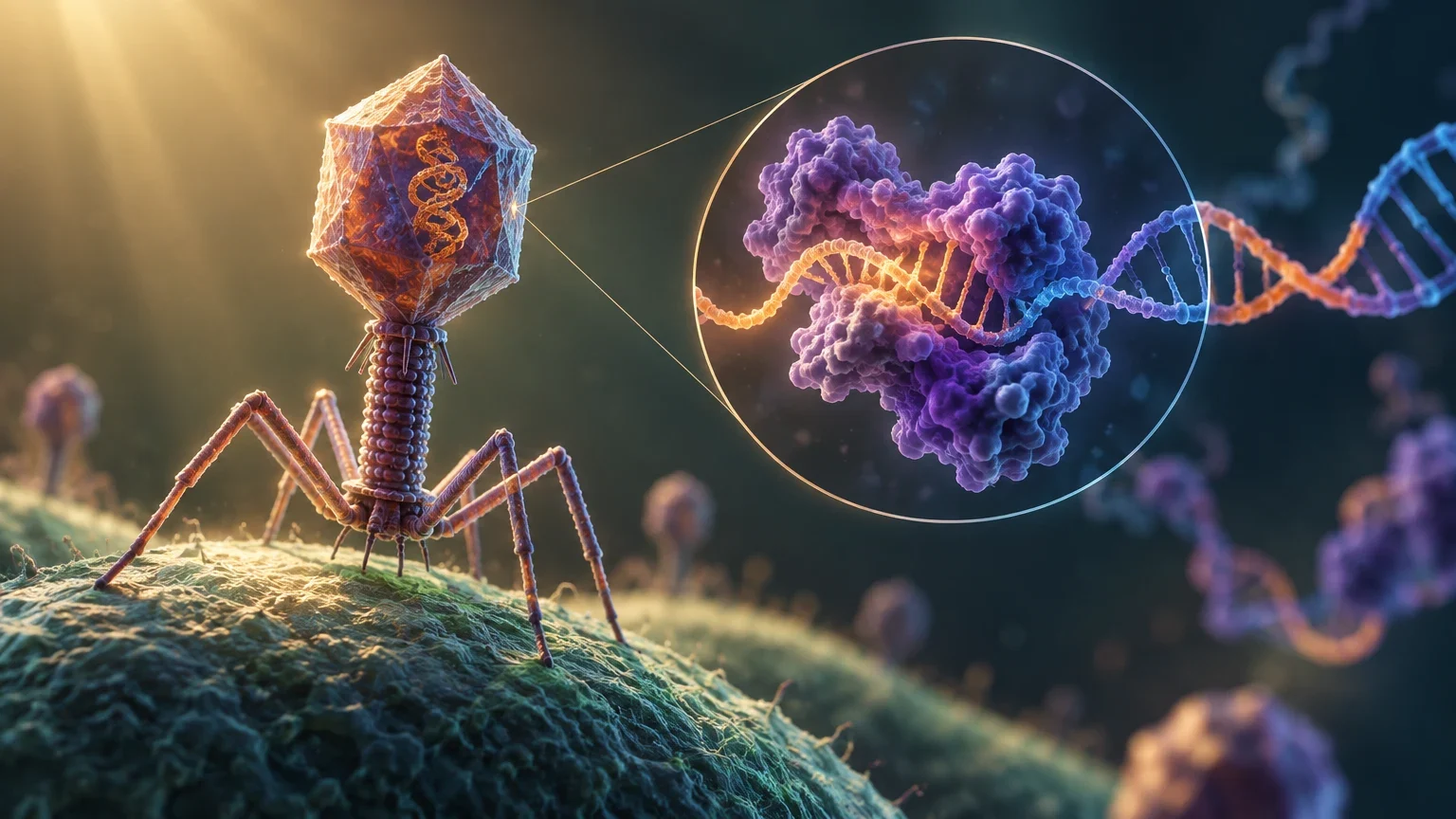
Anthropic says Claude agents detected a pattern in bacteriophage DNA sequences associated with an enzyme system that had not previously been characterized. Bacteriophages are viruses that infect bacteria. The company calls the system ART, short for “array-associated reverse transcriptases.” Anthropic presents the result as one of the early findings from a life sciences research program.
The description needs an important qualification: what is being presented as novel is the system, or the association between an enzyme and a structure made up of repeated sequences—not necessarily the existence of an entirely new class of enzymes. A reverse transcriptase is an enzyme that can synthesize DNA from RNA. According to the information published, a long array of DNA repeats lies next to the enzyme’s gene. Anthropic says that arrangement is somewhat reminiscent of repeats associated with CRISPR.
The fact that two systems share a structural feature does not show that they have the same function, operate through the same mechanism, or can be used for the same purposes. Anthropic acknowledges that it does not yet understand what ART does. So “CRISPR-like” is a limited comparison about the observed arrangement, not a conclusion that ART is a gene-editing tool, a therapy, or a tested experimental product.
What Claude and the researchers did
According to Anthropic, Claude helped search large collections of DNA sequence data for patterns. The company describes the work as a collaboration between AI agents and scientists: the agents processed data and flagged a lead that was then examined by the human team. Coverage of the announcement also credits researchers with providing the initial direction and conducting the laboratory experiments. These are two different stages and should not be conflated: computational analysis that led to a hypothesis, and biological tests intended to investigate it.
Some reports say the process involved 950 agents working for 21 hours and processing 210 million tokens. According to the available coverage, those figures describe the scale of the computational work Anthropic attributes to Claude. By themselves, they do not measure the strength of the evidence, the biological importance of the finding, or the degree of autonomy involved. Nor do they indicate that the agents performed the laboratory experiments.
The phrase “Claude discovered” compresses a chain of tasks, but it can obscure who made decisions and who checked the result. In this case, the company’s announcement assigns data analysis and pattern detection to the agents, while people are credited with the experimental tests. The available evidence does not justify concluding that Claude independently designed and carried out the entire research process.
From a computational pattern to a biological hypothesis
- 01Researchers define the problem and select the data to be analyzed.
- 02Claude agents search DNA sequences for patterns and flag a possible association between repeats and an enzyme.
- 03The human team evaluates the lead and develops a hypothesis about an ART system.
- 04Researchers conduct laboratory tests to investigate the finding; the system’s function remains unestablished.
What the evidence confirms—and what it does not
Anthropic’s announcement and the news reports covering it describe sequence analysis and laboratory checks. According to the company’s account, this supports the claim that the computational lead was subjected to experimental evaluation. However, the available sources do not provide all the protocols, controls, quantitative results, or experimental conditions a reader would need to assess the strength and scope of each test fully.
Coverage of the preprint points to specific scientific limitations: ART’s function has not been established, and it has not been shown that the enzyme uses those RNA sequences as a substrate. It also reports that repeated searches did not detect the pattern again. These limitations do not prove the result is wrong, but they do make it important to distinguish an initial signal from robust functional characterization. Finding a pattern and demonstrating what a system does are different questions.
The sources provided do not document replication by an independent group or external experimental evaluation confirming the result. Coverage describes a preprint and Anthropic’s announcement, but that is not enough to say that the work has passed peer review or been independently replicated. The absence of such confirmation in the available sources does not prove that it has never happened; it means that it cannot be treated as established here.
How to interpret the main claims
| Claim | What it supports | What it does not demonstrate |
|---|---|---|
| Claude detected a pattern in DNA sequences. | Anthropic credits its agents with contributing to the computational analysis. | That AI carried out the entire scientific process on its own. |
| Researchers conducted laboratory tests. | According to the company’s announcement, the lead was examined experimentally. | That ART’s function has been characterized or that any application has been proven. |
| The structure is somewhat reminiscent of CRISPR. | A structural similarity has been described in the arrangement of repeats. | That ART is a gene-editing tool or has CRISPR’s function. |
| Figures were reported for agents, time, and tokens. | The figures provide information about the computational scale attributed to the process. | That those figures establish the biological validity of the finding. |
The CRISPR comparison has limits
CRISPR is known for systems that use molecular components to recognize specific sequences and that have led to gene-editing tools. The information about ART does not establish that the new system recognizes targets in the same way, can cut or modify DNA, or has an equivalent function. The point of comparison Anthropic describes is that a long array of repeats lies near the enzyme, a feature somewhat reminiscent of elements associated with CRISPR.
To determine whether the resemblance has functional significance, experiments would need to establish which molecules are involved, what substrate the enzyme uses, what effect it produces, and under what conditions. The results would also need to be reproduced and characterized adequately. Until then, describing ART as an alternative to CRISPR, an editing technology, or a medical solution would go beyond what has been documented.
What is still needed to assess the finding
The next scientific step is to characterize ART: determine its function, clarify the relationship between the enzyme and the repeats, establish which molecules are involved, and check the results under defined conditions. It also matters whether other teams can find and reproduce the system using independent methods. Those questions would help move from a promising signal to a verifiable biological description.
Attributing a discovery to AI calls for the same caution. A model can speed up searches, suggest connections, or help prioritize hypotheses, but the word “discovery” can encompass very different activities: selecting data, posing the question, detecting a regularity, interpreting its meaning, and validating an explanation. In this case, the sources credit Claude with a significant role in the analysis and human researchers with providing direction and conducting experimental checks. They do not provide a basis for assigning the AI exclusive credit for the entire result.
For now, the appropriately limited conclusion is this: Anthropic says Claude helped detect a pattern associated with an uncharacterized enzyme system in bacteriophages, and researchers conducted laboratory tests. ART’s function remains unknown, the comparison with CRISPR is structural rather than functional, and the available sources do not document independent validation. The announcement is a lead for further research, not evidence of a clinical advance or a proven technology.
Open questions
- The available sources do not give enough detail about laboratory protocols, controls, and quantitative results to assess the tests fully.
- ART’s biological function and the functional relationship between the enzyme and the repeats remain unestablished.
- Coverage of the preprint reports that repeated searches did not detect the pattern again; the sources provided do not explain why.
- The figures for agents, duration, and tokens come from descriptions attributed to Anthropic and are not, by themselves, experimental evidence.
- The sources provided do not document replication by an independent team; this does not establish that replication has not occurred outside those sources.
Keep exploring
Sources consulted
Corrections and transparency
If you spot incorrect or outdated information, send us a correction with the page and source we should review.
Submit a correction