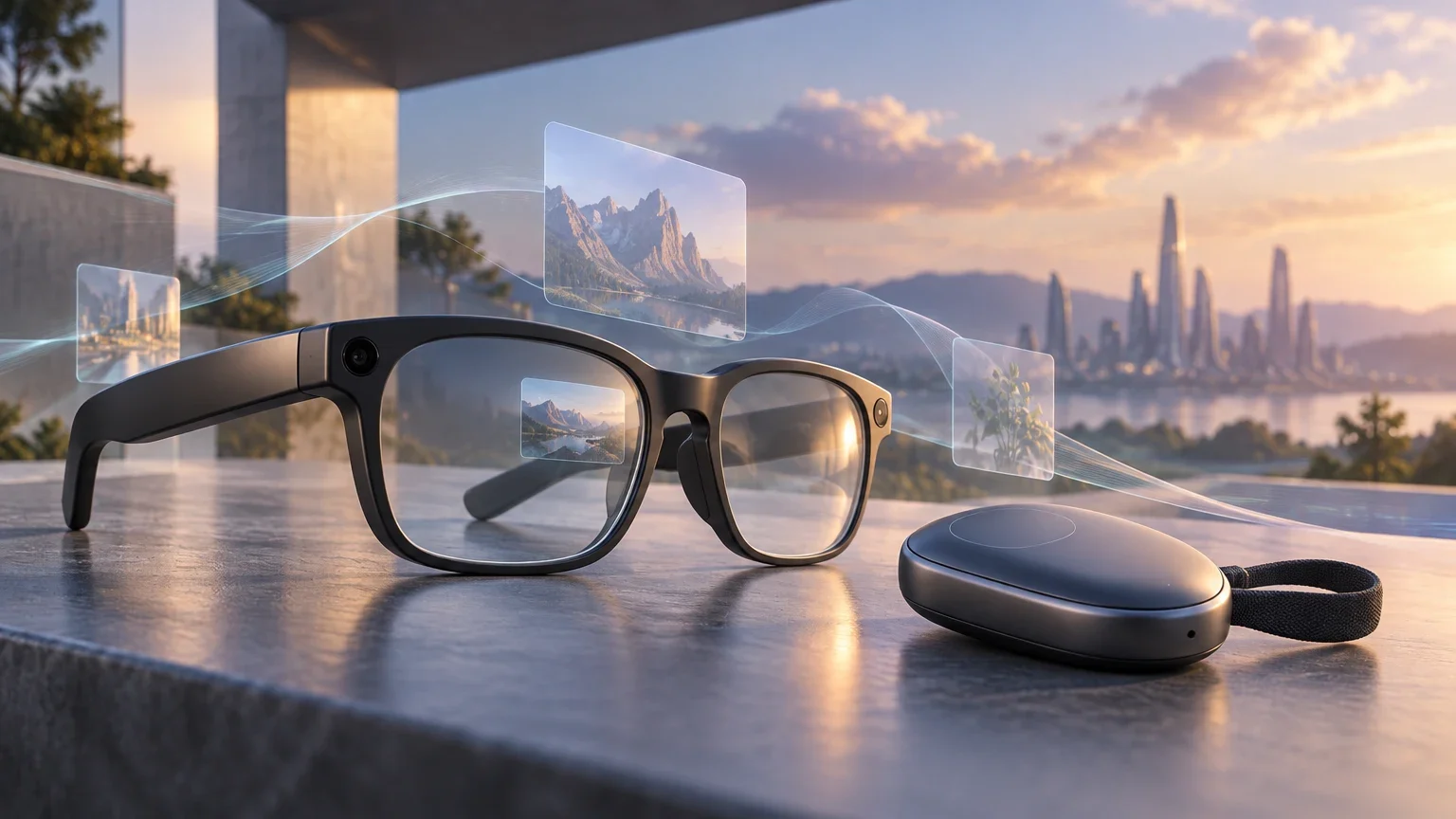
Two new ways to access Muse
At Connect 2026, Meta announced that its artificial intelligence agent Muse will be coming to its smart glasses and unveiled Muse Charm, a small wearable designed for interacting with the agent. The proposal expands the places from which people could access Muse: in addition to phones and computers, they may be able to use the glasses and a pocket-sized accessory. The announcement does not yet resolve important practical questions, however, such as which glasses models will be compatible, which countries will get the features, or what capabilities will be available from day one.
Meta described Muse’s arrival on its glasses as something planned for the coming months, without specifying a date. In its announcement, the company presented the integration as a way to connect with the agent throughout the day, beyond the phone and desktop. That description conveys the product’s aim, but it does not by itself establish how much Muse will be able to do without user input, which tasks might run in the background, or which sensors it will need.
Muse Charm was presented as a pocket-sized device dedicated to Muse. Meta said it would share more details later, so it is worth distinguishing the announced concept from specifications that have not yet been confirmed. Secondary coverage mentions a small screen and voice interaction, but those details are not the same as a complete official specification sheet. The available material also does not confirm whether Charm can operate independently or needs a phone or another connected device.
What Muse will be able to do from the glasses
The main promise is access to Muse without having to take out a phone, through glasses the user is already wearing. Meta has presented the integration as an extension of its agent into more everyday moments and settings. Infobae’s coverage also reports broader Muse updates, including real-time voice conversations, avatars and Mac control. However, that list concerns updates to the agent overall: the available information does not confirm that all of those features will be available on the glasses, or that they will be there at launch.
This distinction matters because an agent’s capabilities can depend on the device, installed software, connection and permissions granted. The fact that Muse can hold a voice conversation on one platform does not prove that the glasses will offer the same experience. Nor have the sources reviewed published an inventory of commands, duration limits, available languages or tasks that can be completed directly from the accessory.
Meta has also not specified which exact models will receive the integration. Bloomberg Línea’s report links Muse to the expansion of the company’s smart-glasses range, but that is not enough to establish that every new or existing model will be compatible. For now, it is safest to treat compatibility as an open question and not assume that a general reference to “the glasses” means universal availability.
How to interpret the announced features
| Item | What has been communicated | What remains unconfirmed |
|---|---|---|
| Muse on the glasses | Meta plans to bring the agent to its glasses in the coming months. | Compatible models, markets and the specific features available at launch. |
| Real-time voice | Infobae includes it among Muse’s broader updates. | Whether it will be available on the glasses, and under what conditions. |
| Avatars and Mac control | These are mentioned in coverage of Muse’s capabilities or Connect updates. | Whether they will be part of the Muse experience on the glasses. |
| Access throughout the day | Meta presents the glasses as another way to connect with the agent. | Which tasks work without opening an app, and what activity takes place in the background. |
Muse Charm: a dedicated device with specifications still to come
Muse Charm is a pocket-sized wearable announced as a way to make the agent easier to access without having to wear the glasses. TechCrunch describes it as a new mobile home for Muse, while Business Insider España, citing people close to the product, says it is intended to be held in the hand rather than necessarily worn. These descriptions help explain the format, but they do not replace an official specification from Meta.
Some secondary reports attribute a small screen and the ability to talk to Muse by voice to Charm. Another report, published by Investing.com and attributed to Reuters, mentions 5G connectivity and use without a phone. Without equivalent confirmation from Meta in the sources provided, these details should be treated as reported information awaiting corroboration, not as settled product features.
Business Insider España also reports that two devices may be able to recognize and interact with each other when brought close together. That possibility comes from sources close to the product, not from the official announcement described in the available sources. It therefore cannot be presented as a final feature. Nor is it clear how it would work, what information the devices might exchange or whether it would require consent from both users.
The distinction between a demonstration, a planned feature and a retail product specification matters especially for a product that has so far been described in broad terms. The name Muse Charm and its purpose—offering another way to interact with the agent—are supported by the announcement. Battery life, connectivity, controls, price and the precise relationship with a phone have not been established.
What to check before judging Charm
- 01Check whether Meta publishes a specification sheet, and distinguish it from details attributed to news sources.
- 02Find out whether the device requires a phone, its own mobile connection or another type of internet connection.
- 03Check which interactions it supports: voice, screen, physical controls or possible features between devices.
- 04Wait for information about availability, price, battery life and country restrictions before assessing its everyday usefulness.
Availability and compatibility: there is still no complete answer
The available official information places Muse’s arrival on the glasses in the coming months, but gives no precise launch date. For Charm, Meta has previewed the device and said it will share more details later. Think’s coverage mentions December, but that date is not confirmed by the official material provided and should not be treated as a definitive schedule.
The sources also do not specify the markets where Muse will be enabled, the initial languages, account requirements or regional differences. Without those details, it is impossible to know whether the rollout will be simultaneous or gradual, or whether some features will be reserved for particular models. The availability of the glasses and the availability of Muse on them are related, but not identical: a model might be sold in a country without all of its software features being enabled there.
For someone who already owns Meta glasses, the announcement does not establish that they will get an automatic update or that older models will be compatible. For anyone considering Charm, it is likewise too early to assume that the device can replace a phone. Until Meta publishes the requirements and terms, both possibilities remain open questions.
Privacy and use: the unanswered questions
Putting an assistant on glasses changes the context of use: access to voice and, depending on the model, sensors such as a camera may occur in shared spaces. The sources provided do not detail what data Muse will need on the glasses, whether it will process audio continuously, what information will be retained, how long it will be kept or which specific controls users will have. They also do not clarify whether the feature will require additional permissions or a permanent connection.
Meta has general documentation on responsible innovation and privacy controls for its glasses and headsets. That material can provide context on camera, voice and notification controls across its products, but it does not by itself answer specific questions about Muse or Charm. A privacy feature described for other models or uses should not automatically be assumed to apply to these devices.
In Charm’s case, it remains to be seen whether the device will have a microphone, a screen or other sensors, and how it will indicate that it is active. If it can ultimately interact with other Charms, users will also need to know how that exchange is authorized and what information is shared. The possibility mentioned by sources close to the product does not establish what privacy mechanisms would apply.
Before launch, useful information for users would explain what is enabled by default, how to stop listening or interaction, which indicators show that the system is active, what data is sent to servers and how it can be deleted. It would also be useful to know whether the device can be used with limited functionality or without enabling every permission. The available sources do not answer these questions yet.
What’s changing and what remains to be learned
The confirmed change is about access: Meta wants Muse to be available beyond phones and desktops, and has announced that it is coming to the glasses alongside a dedicated pocket-sized device. The real scope of that expansion will depend on which features are enabled in each format and on conditions that have not yet been published.
For now, the clearest way to understand the announcement is to separate three levels of information: Meta’s announcement that Muse is coming to the glasses and its unveiling of Charm; the Muse features described by news outlets that are not necessarily confirmed for each device; and hardware details attributed to secondary sources that still await official confirmation. That distinction helps avoid confusing the product’s direction with a definitive list of capabilities.
The news will interest people following portable AI assistants, but it is not yet possible to compare the Muse experience on the glasses with Charm in detail. That will require Meta to publish compatibility, timing, markets, connection requirements and privacy controls. Until then, the promise of having an agent available at more points throughout the day should be read as a product goal, not a guarantee of continuous operation or independence from a phone.
Open questions
- Which Meta glasses models will be compatible with Muse, and whether older models will receive updates.
- Which features will be available on the glasses at launch and which may arrive later.
- The exact launch date and markets for Muse on the glasses and Muse Charm.
- Whether Charm needs a phone or another connected device, or can connect independently.
- Whether reports of a small screen, 5G and interaction between devices describe final features.
- Which sensors, permissions, data and specific controls Muse will require in each format.
Keep exploring
Sources consulted
Corrections and transparency
If you spot incorrect or outdated information, send us a correction with the page and source we should review.
Submit a correction