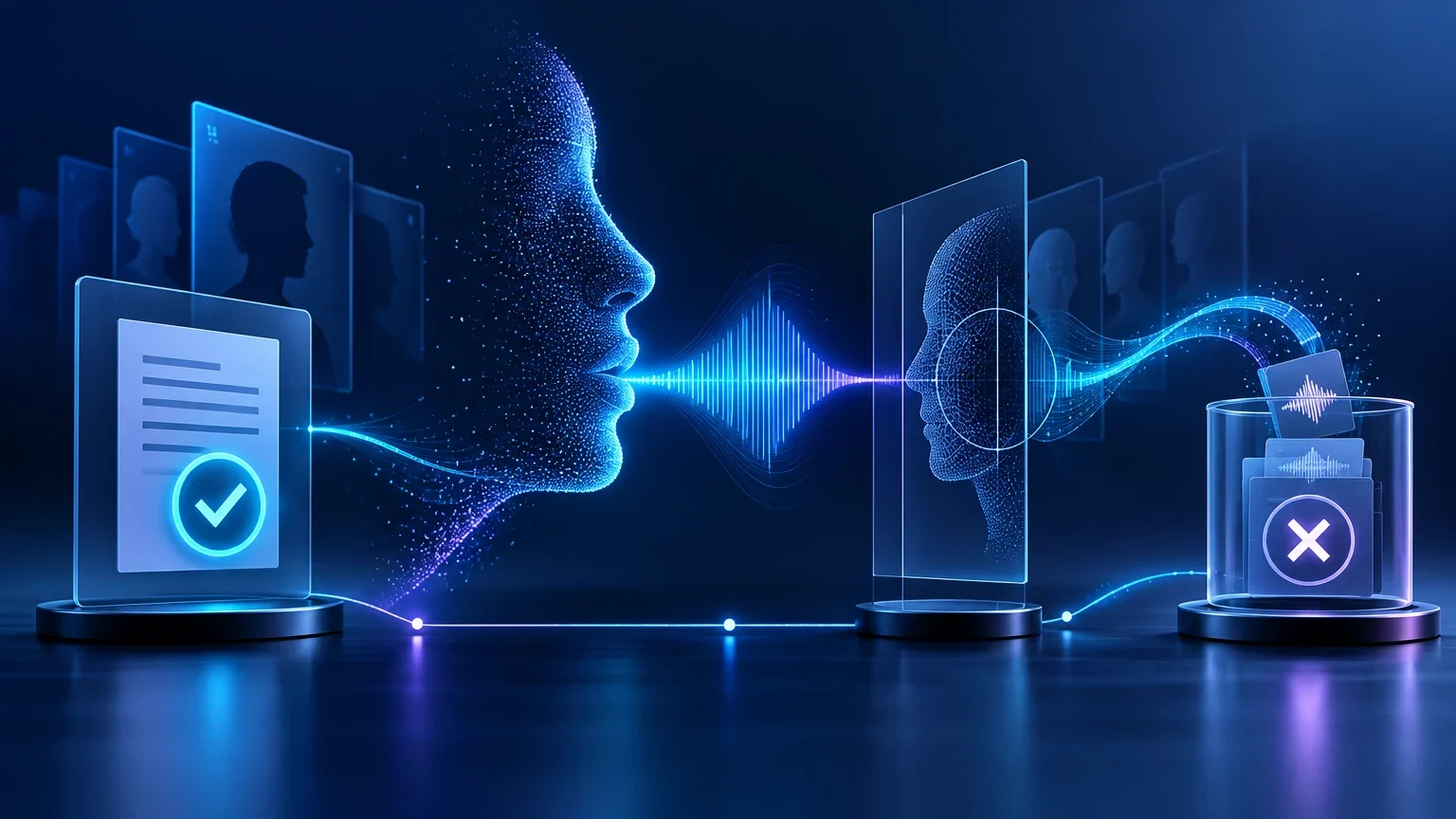
The decision a voice demo cannot resolve
A text-to-speech demonstration can answer questions about quality, language, latency, or expressiveness. On its own, it does not resolve an earlier question: who can authorize use of a voice, for which purposes, and subject to which limits. In production, risk is not concentrated only in creating the file. It also arises when a voice model is reused in another channel, a recording is translated, a script is changed, material is delivered to a distributor, or a campaign remains live after the authorization terms have changed.
It is useful to treat authorization as a verifiable relationship between an authorized person or entity, a voice or set of samples, a defined purpose, and a period of validity. That relationship should be available for review before generation and publication, rather than being reconstructed manually after a complaint. A contract, form, or confirmation recording may be part of the evidence, but it is not enough if it is not linked to the assets and workflows it enables.
This discipline matters whether the team uses a licensed voice catalog, integrates a professional cloning service from a provider such as ElevenLabs, or operates its own voice model. It is also independent of the specific model used for generation. The technology choice may change, while the need to know the scope of authorization, the voice version, and the destination of every output remains.
The General Data Protection Regulation establishes principles of purpose limitation, data minimization, and storage limitation. For a voice team, those principles support separating the evidence needed to demonstrate authorization from audio samples, identity documents, and technical logs; each category may require different access controls, purposes, and retention periods. They do not mean that everything must be retained indefinitely in order to preserve traceability.
Three categories that must not be conflated
A licensed catalog voice is a voice made available under terms defined by the party offering it. The team using it must verify that those terms cover its specific case: for example, commercial use, customer support, a particular territory, or the creation of advertisements. The fact that a voice is available in an interface does not by itself demonstrate that every use, transformation, or redistribution is allowed.
Authorized cloning of an identifiable person creates a more direct link between the rights holder and the output. In addition to verifying identity or representation, the authorization should distinguish among synthesizing new text, retaining samples, training or improving a model, translating, dubbing, adjusting timbre, allowing operator access, and transferring work to subcontractors. Each of those operations may have a different material scope.
A voice designed not to imitate a particular person reduces some risks, but it does not eliminate the possibility of accidental resemblance or of a context suggesting that a person is involved. Likeness is not a binary property that can be resolved solely through a statement from the provider or creative team. It may depend on timbre, prosody, accents, recognizable phrases, the name attached to a character, and the publication context.
For that reason, the initial classification should not function as an exemption. A catalog voice can be used in a way that suggests impersonation; a voice created from scratch can approach a recognizable person; and a cloning arrangement that was initially authorized can fall outside scope when used for a new purpose. The category helps determine initial controls; it does not replace review of the actual use.
Initial classification and recommended control
| Situation | Decisive question | Minimum control | When to strengthen |
|---|---|---|---|
| Licensed catalog voice | Does the license cover the channel, territory, and purpose? | Record the version, applicable terms, and resulting asset | Campaigns, brand voices, or uses that could suggest personal identity |
| Authorized cloning | Did the rights holder or representative authorize this specific transformation? | Verify identity or authority and link the authorization to the voice | Translation, training, sublicensing, advertising, or sensitive messages |
| Voice not associated with a person | Could the result be mistaken for an identifiable person? | Run a likeness test and record the decision | Resemblance identified by reviewers, the target audience, or an impersonation context |
The minimum authorization record
The record does not need to become an indiscriminate archive of personal data. It should contain the minimum needed to answer two questions reliably: who authorized the use, and what did they authorize? Identity can be verified through a process appropriate to the risk, while the stored evidence should be proportionate. In some cases, recording the result of a check and the reviewer who performed it will be sufficient, rather than replicating sensitive documents or samples across multiple systems.
When a representative acts, the record should identify the represented person or entity, the source of that authority, its validity, and any limitations. If a provider performs verification during its cloning workflow, that verification can be a useful signal, but it does not replace the contractual and operational definition of the customer’s intended use. ElevenLabs documentation describes a professional voice-cloning workflow that includes a challenge phrase to verify the voice and a manual-review route before training. That is a measure for verifying the provider’s process, not universal proof that every subsequent use is authorized.
Authorization should state purposes in understandable, operational terms. “Synthetic voice use” is too broad to decide whether a team may narrate an internal course, an advertisement, a conversational assistant, or a dub. Record channels, territories, languages, duration, script types, permitted transformations, training or improvement, subcontracting, and the possibility of revocation. If a condition is unclear, the system should flag the use for review rather than assume it is permitted.
It is also useful to distinguish authorization to generate, authorization to publish, and authorization to retain. This separation prevents a sample collected for a technical test from moving without control into training, and prevents a recording approved for a limited campaign from remaining available for later reuse. Minimization requires each field in the record to serve a specific purpose and for its retention period to be reviewed.
Onboarding an authorized voice
- 01Create an internal rights-holder identifier without using it as the public name of the voice.
- 02Verify identity or authority of representation with a method proportionate to the risk, and record the result, date, and reviewer.
- 03Define the scope: purpose, channels, territories, languages, transformations, training, subcontracting, validity, and revocation.
- 04Assign a voice version and associate it exclusively with the approved record.
- 05Configure blocking rules for out-of-scope uses and a review date before expiry.
From consent to execution: the record that explains every audio asset
Useful traceability is created at the point of generation and publication. For every asset, the team should be able to retrieve an authorization identifier; voice identifier and version; model or service used; script or instruction version; responsible operator or system; generation date; approver; destination channel; and publication status. Not all of these elements prove consent; together, they make it possible to locate the authorization invoked and assess whether the use complied with it.
This record must work with automated workflows. If an assistant generates spoken responses in real time, it will not be practical to approve every individual file. In that case, the link can be established among a generation policy, a versioned set of scripts or instructions, the enabled voice, and the deployment environment. It must be clear which changes require a new approval: for example, changing the voice, expanding the territory, adding translation, altering the class of messages, or using a new version of a model.
Content credentials and technical provenance can complement this record. The C2PA specification describes signed manifests and cryptographic relationships for expressing information about the creation and modification of an asset, including external-manifest mechanisms. It can help link distributed audio to provenance information. However, a signature or manifest does not create consent or demonstrate that an authorization is sufficient: it preserves information asserted by workflow participants and depends on how identity, signing, and the availability of associated data are managed.
Keep identifiers that the public may receive separate from those reserved for internal operations. External disclosure should not reveal personal documentation or unnecessary security details. At the same time, the internal record must be accessible to people investigating complaints and performing removals, with access controls and a change history.
Likeness testing and enhanced review
A likeness test should assess whether a reasonable audience could attribute the voice to an identifiable person, especially in the context of use. It is not a single scientific test or universal threshold. An acoustic measurement, where used, may provide a signal, but it should not replace human judgment about perceived identity, editorial presentation, script, and possible association with a specific person.
Before publishing a higher-risk voice, conduct a review using representative samples: different texts, emotions, speeds, languages, and compression conditions. Ask reviewers to document whether they recognize or attribute the voice to anyone, which features cause that impression, and whether the name, image, product, or context increases confusion. When possible, separate creative review from the person who configured the voice in order to reduce confirmation bias.
Define in advance what happens when results are ambiguous. It may be necessary to redesign the voice, change parameters, remove characteristics from a delivery, reframe the presentation, or escalate to legal and operational review. The objective is not to certify that no listener will find a resemblance, which the team cannot guarantee with certainty. It is to make a defensible, repeatable decision using the information available.
NIST’s Generative AI Risk Management Framework profile includes practices related to documentation, testing, human oversight, provenance, and risk management. Applied to voice, it can serve as a methodological basis for assigning responsibilities, preserving assessment results, and reviewing controls when the model, context, or incident signals change.
Short likeness-testing protocol
- 01Define the audience, context, and people with whom confusion could arise.
- 02Generate a set of samples that covers the intended use, including sensitive text and delivery variations.
- 03Request independent review and record attributions, doubts, observed features, and listening conditions.
- 04Evaluate the combined effect of audio, name, image, script, and distribution channel.
- 05Approve, redesign, or escalate the decision; repeat the test when the voice, model, or use case changes.
Disclosure and context: informing people without turning the label into an excuse
Disclosing that a voice has been artificially generated or manipulated may be a regulatory obligation in certain circumstances and is also a transparency measure. The European Union Artificial Intelligence Act establishes disclosure requirements for deployers of systems that generate or manipulate audio content constituting a deepfake. The specific application depends on the facts, each participant’s role, and the applicable timeline; the team should assess its case using specialist judgment where doubt exists.
A generic label does not, by itself, resolve the risks of consent, confusion, or deception. It should appear at the moment and through the channel that are relevant to the listener. In an audiovisual work, it may take the form of a visible, accessible notice; in a voice interaction, it may require an audible or textual introduction before the user relies on the content. In a downloadable file, metadata can supplement the information, but may not necessarily replace perceptible disclosure.
Editorial, educational, advertising, and customer-service content carry different expectations. A disclosure should be clear without asserting more than the team can demonstrate. It is better to say that a voice is synthetic or artificially generated when that is the documented fact, rather than claim that it does or does not reproduce a particular person if the assessment cannot support that claim. Retain the exact version of the notice and the channels in which it was displayed.
Disclosure decision by context
| Context | Risk to assess | Operational measure |
|---|---|---|
| Voice assistant | The user may assume they are speaking with a person | Inform the user at the start or before the decisive moment, and record the notice version |
| Advertisement or audiovisual work | The presentation may suggest personal endorsement or participation | Review the voice, images, and attributions; include disclosure appropriate to the channel |
| Internal training | The audio may be reused outside its original context | State the synthetic origin and limit or record downloads where feasible |
| Editorial narration | The voice may alter perceptions of a testimony’s authenticity | Clearly distinguish synthetic narration from statements by real people |
Removal, revocation, and replacement without losing evidence
Removal begins before revocation. An inventory should connect each voice with source assets, final files, campaigns, platforms, caches, distributors, template libraries, and automations. Without that map, a team may disable a voice in the main interface while copies continue to be delivered from an application, a distribution network, or downloadable material.
Revocation does not necessarily have the same effect on every asset. The record should state whether it affects new generations, future publications, already distributed materials, or uses that must be retained because of archiving obligations. If those rules were not agreed or are unclear, the case should be escalated. The decision should not be inferred solely from a technical expiry date.
On receiving a request, first freeze the ability to generate new outputs using the affected voice or authorization. Then determine the scope, prioritize the destinations with the greatest exposure, replace recordings where possible, and request the relevant actions from distributors or subcontractors. Document attempts, confirmations, and limits: a copy downloaded by a third party may not be recoverable, but that limitation does not remove the need to act on channels controlled by the organization.
Preserve closure evidence proportionately. It may be necessary to retain identifiers, dates, decisions, and removal confirmations in order to respond to a later complaint. That does not require keeping voice samples or identity documents for the same period. Apply differentiated retention periods and review who can access each type of evidence.
Seven-step removal response
- 01Record the request, its source, date, and asserted scope.
- 02Validate the identity or authority of the person requesting removal where appropriate.
- 03Suspend new generations and deployments associated with the voice or authorization.
- 04Consult the inventory of assets, destinations, caches, distributors, and automations.
- 05Remove, replace, or unpublish according to the applicable scope, prioritizing the highest-impact channels.
- 06Request confirmation from third parties where they control copies or distribution.
- 07Close with a record of actions, unrecoverable assets, dates, responsible parties, and a review of causes.
Decision matrix and launch checklist
The launch decision should combine three dimensions: identity or likeness, message sensitivity, and actual ability to remove the asset. An advertisement that appears to be attributed to a person, an assistant delivering significant information, and a dub intended for broad distribution do not have the same profile as an internal narration with limited reach. The matrix does not replace legal analysis or a provider’s terms; it organizes operational decisions and reveals when the team lacks enough information.
Before activating an integration, also check which part of the process the provider controls and which part remains with the organization. A service may offer voice verification or an anti-impersonation policy, but the team deciding on scripts, audiences, destinations, and publication needs its own controls for those elements. Likewise, a provider of conversational or voice models should not become the sole source of the authorization and removal record.
A complaint alleging impersonation or unauthorized use requires a response that does not prejudge the outcome. Acknowledge receipt, preserve relevant records, temporarily limit use when the risk justifies it, check the record, and communicate the investigation status. Avoid responding with absolute claims about likeness or ownership while the facts remain unverified. The quality of the response depends on having designed the record before the incident.
Operational decision matrix
| Case | Authorization review | Likeness testing | Disclosure | Removal readiness |
|---|---|---|---|---|
| Public voice assistant | Enhanced: permitted purpose, scripts, and instructions | Enhanced if the voice is identifiable or branded | Normally visible or audible at the relevant moment | High: immediate deactivation and workflow control |
| Content dubbing | Enhanced: languages, territories, and transformations | Enhanced to prevent attribution to the original performer | Assess according to context and applicable rules | High: inventory of versions by language |
| Advertisement | Enhanced: channel, duration, creative approval, and sublicensing | Enhanced | Enhanced where it could affect attribution or authenticity | High: copies, agencies, and distributors |
| Internal training | Verify the internal scope and reuse | Proportionate to the context | Clear, to avoid confusing participants | Medium: platforms, downloads, and repositories |
| Editorial narration | Enhanced: context, attributions, and potential testimonies | Enhanced where there is a risk of confusion | Assess editorially and under applicable rules | Medium or high depending on distribution |
Open questions
- Applicable rules, implementation timelines, and disclosure obligations depend on the jurisdiction, each participant’s role, and the specific characteristics of the content; this guide does not replace legal advice.
- The supplied sources do not provide a universal technical threshold for determining when a voice is too similar to an identifiable person.
- Each provider’s capabilities, contractual terms, and verification workflows can change; they should be confirmed for the specific service, plan, and use case.
- Traceability does not guarantee recovery of every distributed copy, especially where third parties have downloaded or republished files outside the organization’s control.
Keep exploring
Sources consulted
Corrections and transparency
If you spot incorrect or outdated information, send us a correction with the page and source we should review.
Submit a correction