What Genie 4 is and what Google DeepMind announced
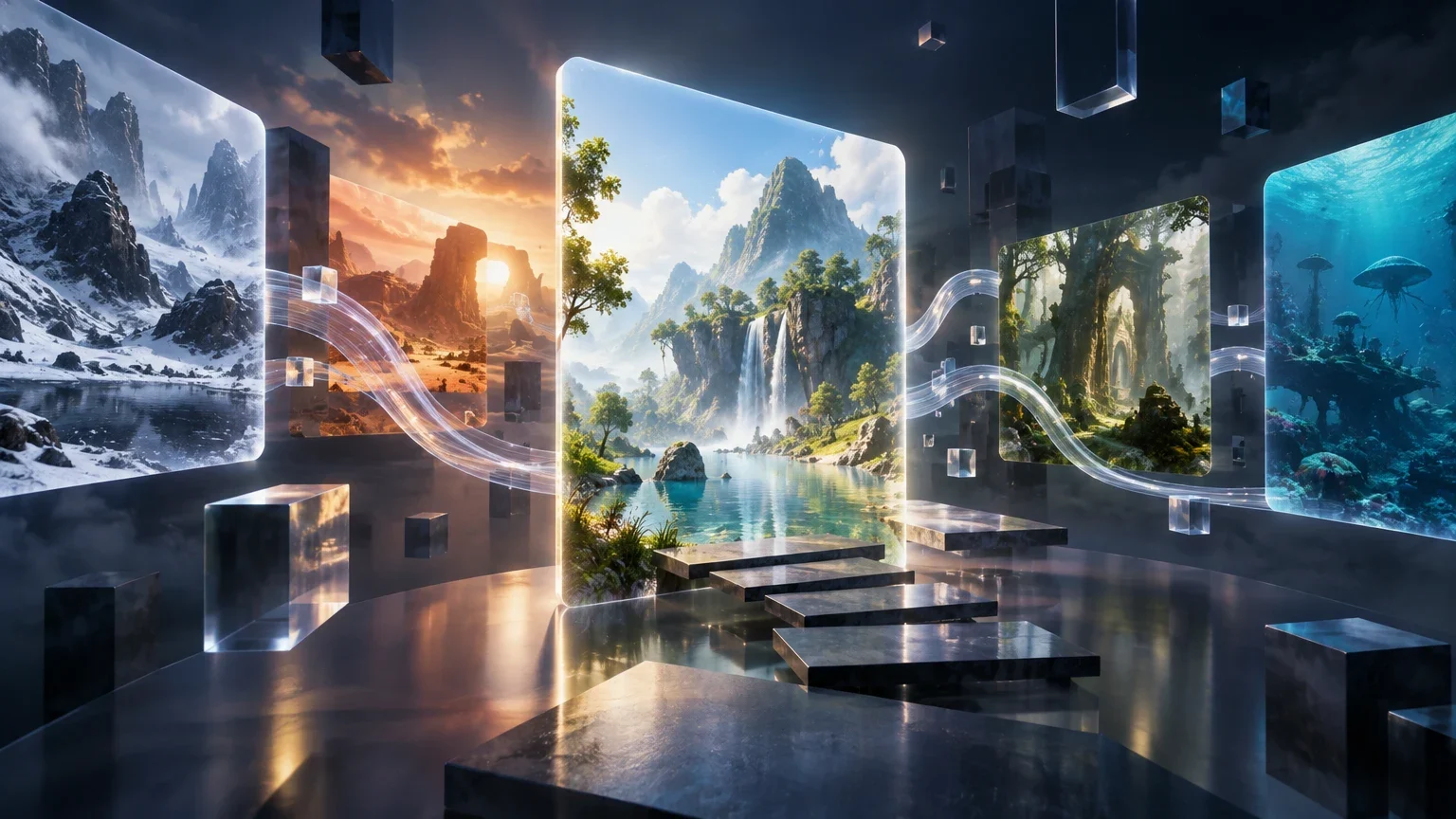
Genie 4 is a Google DeepMind world model: it generates a visual, interactive simulation that users can explore and modify while it is running. The company announced the system on October 27, 2026, describing it as a new step in its research into simulated environments. It is different from generating a finished video clip: the idea is that users can move through a scene and direct changes during the interaction.
Google DeepMind says the model natively generates images and audio, including ambient sounds, music, and interactive dialogue. The company also describes the ability to change the weather, move the camera, or add people and objects using natural-language prompts. These are capabilities announced by Google DeepMind; the company’s publication does not provide an independent evaluation that would establish how reliable or broadly applicable they are across different tasks.
That distinction matters because a convincing visual demonstration is not enough to show that a simulated environment follows stable rules. A model may produce a plausible sequence while still changing objects, details, or spatial relationships as a session continues or prompts are chained together. Google DeepMind itself describes Genie 4 as experimental and acknowledges these limitations.
How interactive simulation works
In an AI-generated interactive simulation, the system produces its representation of an environment as the user observes or moves through it, rather than simply playing back a finished clip. Google DeepMind says Genie 4 generates the world and accepts keyboard navigation and text prompts to guide changes. For example, a user can request a change to the scene and continue exploring without necessarily starting from scratch.
The publication also describes support from Gemini models: they observe how the scene develops, interpret goals, and break them into steps to help guide the simulation. In the published material, Gemini 3.8 Flash is identified as the real-time guiding agent; Google separately mentions experiments combining other models with Genie 4. The company says this combination helps maintain continuity, but the publication does not provide detailed metrics to quantify that effect.
It is useful to distinguish three things: visual generation, interaction, and consistency. A scene responding to a prompt does not mean that every element follows exact physics. Nor does an agent suggesting steps for a task prove that the physical result matches the real world. These are separate properties, and each requires appropriate testing.
How to interpret a demonstration of a generated world
A demonstration lets viewers observe a capability under specific conditions; it does not by itself establish the system’s general performance.
- 01Identify the input the model receives: text, navigation controls, or another signal.
- 02Check whether users can change the scene while it is running or only before it is generated.
- 03See whether the demonstration shows a prolonged session, successive changes, and repeatable results.
- 04Distinguish a plausible appearance from validated physical and spatial interaction.
What evidence the announcement provides
The available primary source is Google DeepMind’s publication. It presents audiovisual examples and explains the capabilities the company attributes to Genie 4, its access plans, and the limitations it acknowledges. It is a relevant source for understanding what the lab announced and how it describes the system, but it is not an external test of those claims.
The publication does not include a detailed technical report, quantitative metrics for latency or quality, model weights, or a reproducible evaluation protocol. It also does not establish an independent comparison with Genie 3 or other systems. As a result, terms such as “more realistic,” “real time,” or “improved physical understanding” should be read in the context of the announcement: the material available does not translate them into a verifiable measure for readers.
The difference between an announcement and a practical evaluation is particularly important for a world model. Assessing its usefulness would require knowing, among other things, how latency is measured, how many interactions remain consistent, which types of changes were tested, and what criteria determine whether a response is successful. Without those details, its performance cannot be established precisely, compared fairly, or assumed to be reliable for a specific application.
What the available evidence supports
The official publication supports claims about the announcement and Google DeepMind’s description. It does not replace an external evaluation or a performance report.
| Claim | What the primary source supports | Limitation |
|---|---|---|
| Genie 4 was announced as a world model | Google DeepMind presents it for that purpose | This alone does not show that it works for every environment or task |
| Audio generation and text-based interaction | The company describes these capabilities and shows examples | No independent metrics on quality or accuracy are provided |
| Consistency during simulation | Gemini is described as helping guide the scene | The company itself acknowledges drift and consistency problems |
| Potential use in robotics or creative work | The company mentions experiments and exploration with collaborators | This does not demonstrate that Genie 4 can replace production tools or validated simulators |
Acknowledged limitations and open questions
Google DeepMind says visual details and object permanence may change over time, particularly in long sessions, after several complex edits, or when moving through a scene. The company also lists complex physical interactions, audio accuracy, rendering legible text, spatial accuracy, and long-term consistency as areas still under research. These limitations constrain what can be concluded from the demonstrations.
The maximum duration of a simulation should not be confused with a guarantee of continuity. A scene may remain active for a certain period and still accumulate visual errors or respond differently to a repeated prompt. The publication offers no metric for setting a general threshold for stability, nor a public protocol for comparing results under the same conditions.
The verified sources also do not provide sufficient grounds to say that Genie 4 is available to everyone or has broad commercial use. Google DeepMind says access began with trusted testers and that it plans to expand access to Google AI Ultra subscribers and early-access partners using the Gemini API and Google AI Studio. The consulted publication does not establish the date or conditions for broader availability.
Potential uses: exploration, not automatic replacement
Google DeepMind presents Genie 4 as a tool for creating interactive prototypes, exploring audiovisual ideas, and studying simulated scenarios. In film or video games, a navigable scene could help teams test concepts or visualize alternatives. In robotics, a synthetic environment might help explore situations before a task is transferred to a physical system. These are research and experimentation possibilities, not outcomes demonstrated across all those industries.
The consequences of an error matter when evaluating a specific use. A preliminary simulation intended to inspire a scene may tolerate variations that would be unacceptable if the system were used to train a robot or represent a critical physical process. In those cases, teams would need to measure correspondence with the real world, repeatability, and scenario coverage, as well as check what external controls are in place.
Genie 4’s announcement is significant as a system combining visual generation, audio, and real-time interaction. The publicly demonstrated scope remains limited: the primary source is the company’s own account, access began as a preview, and the company acknowledges limitations. Until independent evaluations and reproducible criteria are available, Genie 4 is best understood as experimental research—not proof that generated worlds are stable or production-ready.
What to check before using a simulation
The level of validation needed depends on the application and the cost of an error.
| Exploratory use | Useful checks |
|---|---|
| Visual ideation or previsualization | Review whether requested changes appear and whether the scene serves the creative purpose |
| Interactive prototype | Test controls, chained changes, and stability across repeated sessions |
| Research or agent training | Compare behavior against reference scenarios and measure relevant errors |
| Robotics or decisions with physical consequences | First validate in appropriate simulators and controlled tests; a realistic appearance does not prove physical fidelity |
Open questions
- The publication does not provide detailed metrics for latency, stability, or generation quality across different tasks.
- The consulted publication does not include a full technical report, model weights, or a reproducible protocol for independently verifying the announced capabilities.
- General availability and a confirmed date for broader access are not established.
- Genie 4’s usefulness for robot training or production workflows requires application-specific validation; the announcement does not show that it can replace existing tools.
Keep exploring
Sources consulted
Corrections and transparency
If you spot incorrect or outdated information, send us a correction with the page and source we should review.
Submit a correction