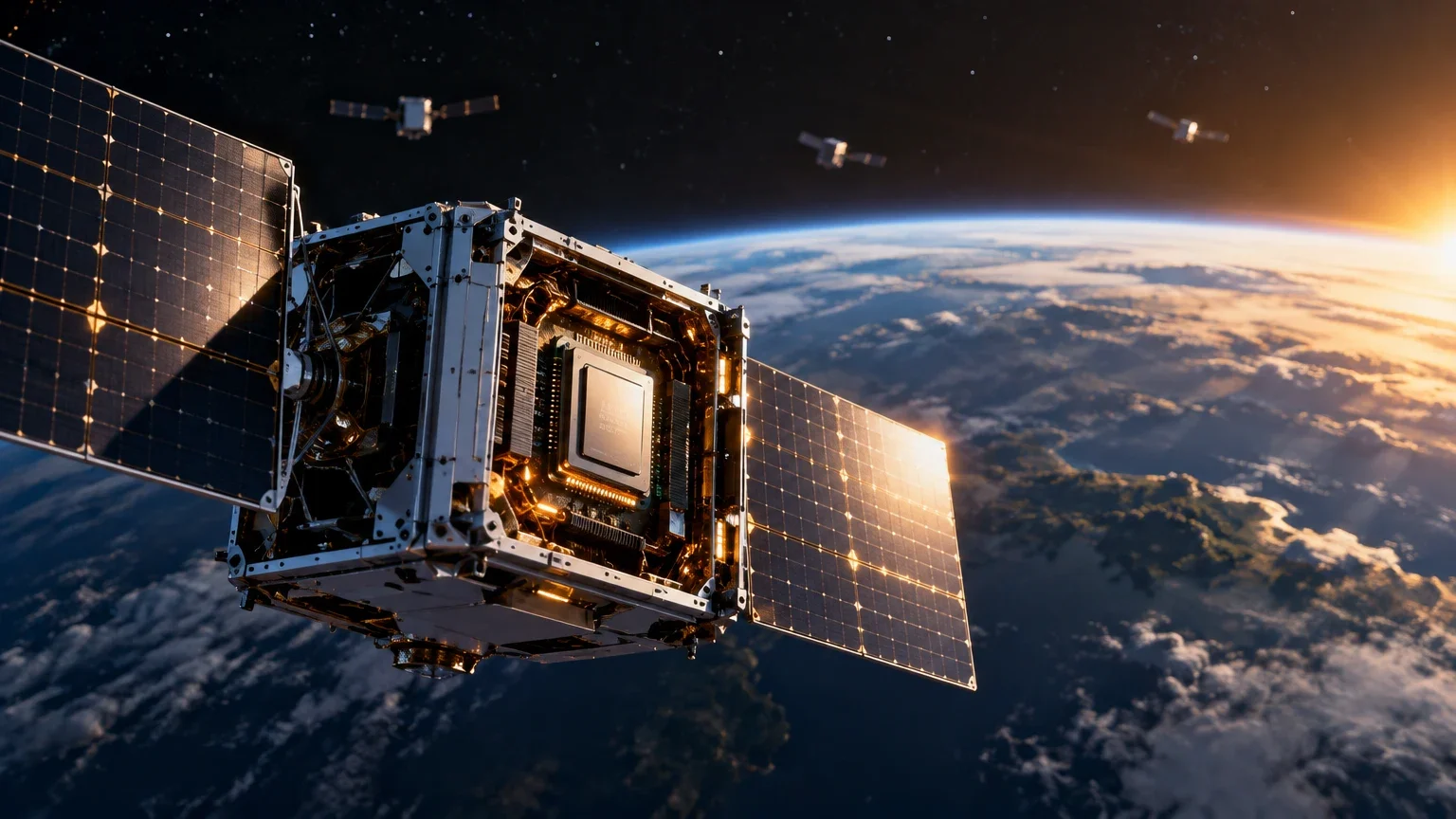
The first AI inference from space
Google announced on October 30 that its open model Gemma 4 generated a response from Earth orbit. The test involved sending an instruction to the satellite to write a haiku about space, a simple task designed to validate the communication and processing chain.
The response arrived as the craft passed near Svalbard, Norway. The generated poem, translated from English, described the Earth and the flow of data. This milestone confirms that the system can process the request in orbit and return the result to Earth, a fundamental step for space computing.
The test demonstrates a complete request-and-response sequence in orbit: an instruction reached the satellite, the model generated a reply, and the reply returned to Earth. Because the task was a short haiku, it shows that this communication and processing chain worked for a simple request; it does not establish how the system would perform on more demanding workloads.
The satellite’s passage near Svalbard marks when the response arrived, while the poem itself was generated in English and then translated. The demonstration therefore concerns both onboard inference and the ability to send its output back through the communication link, rather than a general measure of the model’s quality.
Satellite architecture and TPU hardware
The satellite, built by Planet Labs and launched on October 1 on a SpaceX mission, is part of Project Suncatcher. It carries four TPU chips, though it can only use one at a time during brief periods. This configuration acts as a testbed, not a full data center.
TPUs (Tensor Processing Units) are integrated circuits designed specifically to accelerate machine learning workloads. Unlike CPUs or GPUs, TPUs use a systolic array architecture that allows them to perform multiplication and accumulation operations at high speed, optimizing performance for neural networks.
The four-chip arrangement gives the prototype hardware to test, but the constraint that only one TPU can operate at a time, and only briefly, limits what the demonstration can establish about sustained computing capacity. It is a test platform, not evidence that the satellite can host a full data center.
A systolic array moves data through an organized sequence of processing elements, supporting the repeated multiplication and accumulation operations used in neural-network workloads. This specialized design can accelerate those operations, while the comparison with CPUs and GPUs describes differences in architecture and typical strengths rather than a guarantee that one processor type will be faster for every task.
Comparison of AI accelerators
Key differences between processing architectures for artificial intelligence.
| Feature | CPU | GPU | TPU |
|---|---|---|---|
| Design | General purpose | Massive parallelism | Specialized systolic array |
| Strength | Flexibility | Simultaneous multiplications | Fast matrix operations |
| Limitation | Memory bottleneck | Memory access per calculation | AI specialization |
Energy and cooling challenges in the vacuum
The space environment poses unique difficulties. Although the cold seems favorable, in the vacuum there is no air to transport the heat generated by the processors. Google is investigating systems with thermal pipes and radiators to dissipate energy, a critical engineering challenge for continuous operation.
Available energy is limited. The prototype's solar panels provide around one kilowatt, a quantity comparable to a household appliance. This restriction forces the chips to operate in bursts of 15 to 20 minutes to avoid overloading the satellite's power and heat systems.
In a vacuum, processors cannot transfer heat to surrounding air, so thermal management must move heat away through hardware such as thermal pipes and radiators. Google is investigating those systems; their presence in the research does not establish that continuous operation has already been achieved.
The prototype’s roughly one-kilowatt solar supply and brief operating bursts constrain the time available for computation. The stated 15-to-20-minute periods reflect the need to manage the satellite’s energy and heat limits, not a demonstrated schedule for uninterrupted service.
Processing flow in the satellite
Sequence of events during AI execution in orbit.
- 01The ground station sends the instruction during the communication window.
- 02The satellite receives the request and activates the available TPU.
- 03The TPU processes the inference of the Gemma 4 model.
- 04The result is transmitted back to the ground station.
- 05The system enters standby mode until the next window.
Radiation and long-term viability
Space radiation is the major unknown for the hardware. Google exposed its chips to a proton beam at the University of California, Davis, to simulate these conditions. The results indicated that the chips could withstand more radiation than they would receive during five years in orbit, although minor logical errors were detected.
The reported error rate is low for typical inference, sitting around one in a million. However, this could pose a problem for large-scale training runs, where thousands of chips operate for months. Large-scale viability remains unconfirmed.
The proton-beam test provides a way to examine how the chips respond to radiation, but the reported comparison with five years in orbit is a test result, not proof of error-free operation over that period. Minor logical errors were detected, and the account does not establish how frequently every type of error would occur during prolonged use.
An error rate around one per million is reported for typical inference, but that figure does not by itself establish reliability across all requests or operating conditions. During training, errors could accumulate across long runs involving many chips and affect convergence unless robust correction mechanisms are used; large-scale viability remains unconfirmed.
Future prospects and competition
The ultimate goal of Suncatcher is to build a distributed infrastructure of satellites connected via optical links. Google estimates that in certain orbits, near-permanent exposure to the Sun would allow obtaining up to eight times the electricity that equivalent solar panels would produce on Earth.
The next goal is to experiment with two interconnected satellites in 2027. Other companies, such as SpaceX, are also pursuing versions of this idea, though Google is the first to demonstrate the execution of a data-center-grade TPU in space. Commercial viability depends on reducing launch costs and resolving orbital maintenance challenges.
The eightfold electricity estimate applies to certain orbits and compares the output of equivalent solar panels with terrestrial production. It is a projected energy advantage under those conditions, not a measured guarantee for a completed satellite network or proof that the project would be commercially viable.
The proposed 2027 experiment would connect two satellites, while the broader Suncatcher goal involves a distributed network using optical links. Reaching that larger design still depends on reducing launch costs and addressing orbital maintenance, so the planned experiment should not be confused with an operational commercial service.
Keep exploring
Sources consulted
Corrections and transparency
If you spot incorrect or outdated information, send us a correction with the page and source we should review.
Submit a correction