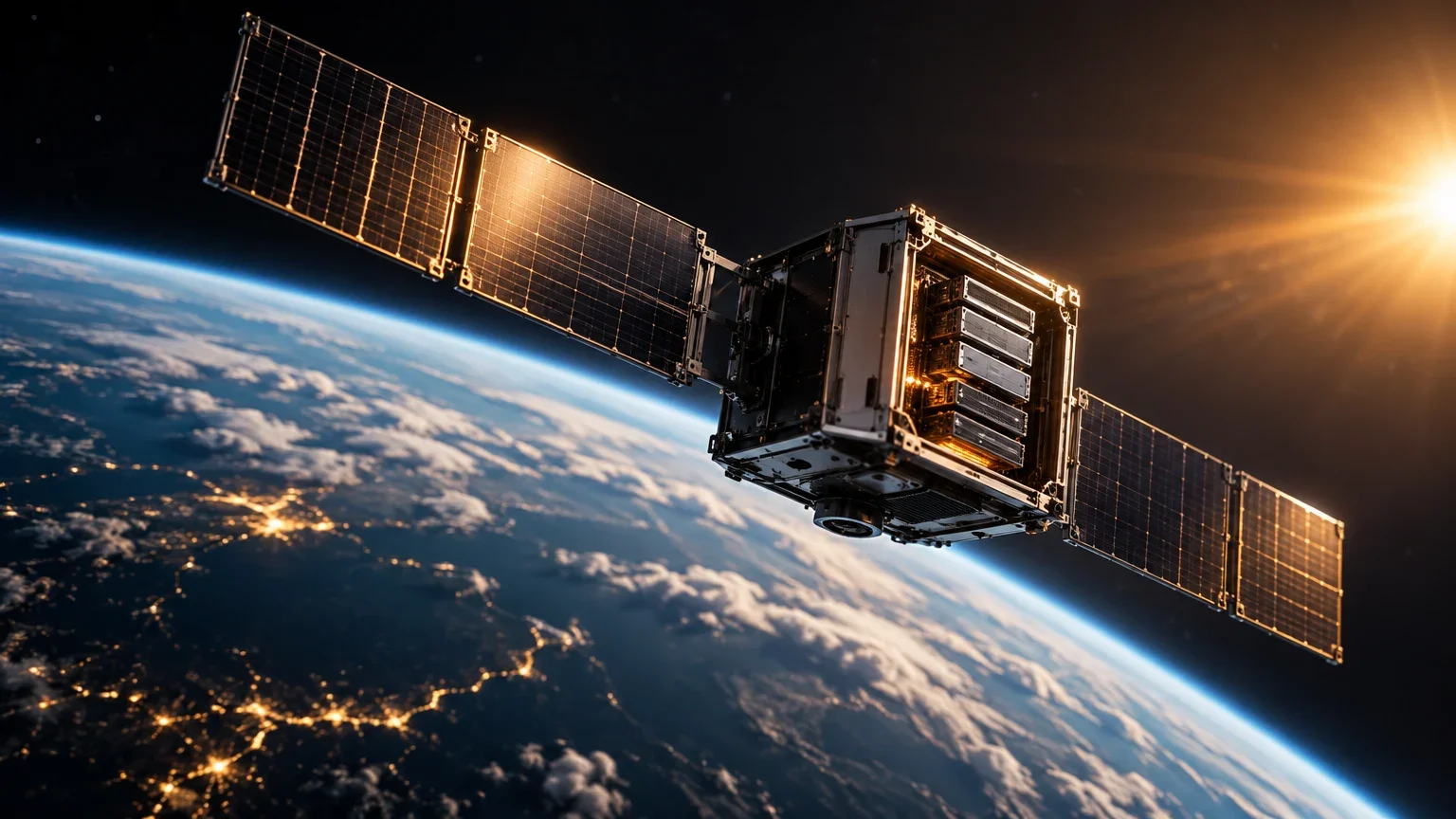
Confirmation of the first AI response from space
Google has confirmed that its prototype satellite, known as MVP (Minimum Viable Product) within the Project Suncatcher initiative, returned an artificial intelligence-generated response while in orbit. This milestone, reported in late October 2026, marks the first time a data-center-grade Tensor Processing Unit (TPU) has executed an inference task outside Earth.
The task involved generating a short text, described in official communications as a poem or haiku about space, using the Gemma 4 model. The instruction was sent from a ground station and the response was transmitted back during an orbital pass near Svalbard, Norway. Although the demonstration is symbolic, it validates the central hypothesis of the project: that AI hardware can operate under the extreme conditions of the orbital environment.
Hardware architecture and energy limitations
The MVP satellite, built by Planet Labs in collaboration with Google, is approximately the size of a domestic refrigerator. On board, it carries four TPU chips, specifically designed to accelerate artificial intelligence workloads. Collectively, the processing capacity of these four chips is equivalent to that of a single conventional server in a terrestrial data center.
The primary constraint is not computational power, but available energy. The satellite's solar panels generate approximately one kilowatt (kW) of power, a quantity comparable to the consumption of a high-power household appliance. Due to this limitation and the challenges of heat dissipation, the chips cannot operate continuously. Tests indicate that the TPUs can only operate in bursts of between 15 and 20 minutes before requiring a shutdown to cool down and prevent overheating.
Technical specifications of the MVP prototype
Summary of the satellite's main characteristics and operational limitations confirmed by technical sources.
| Component | Detail | Operational Limitation |
|---|---|---|
| Processors | 4 TPU chips (Trillium) | Equivalent to 1 terrestrial server |
| Energy | ~1 kW from solar panels | Intermittent operation |
| Session Duration | 15-20 minutes | Requires subsequent cooling |
| AI Model | Gemma 4 | Inference of simple queries |
Engineering challenges: cooling and radiation
Cooling in a vacuum is one of the major obstacles for space computing. On Earth, heat is dissipated through convection (air) or conduction (liquids). In space, with no atmosphere, heat can only be expelled via radiation. Google has developed a system combining heat pipes and radiators to transfer heat from the chips to external surfaces that emit it into the vacuum. This system has been tested in terrestrial vacuum chambers, but its real-world behavior is only now being validated in orbit.
Cosmic radiation and solar events represent another critical risk for electronics. Before launch, Google subjected the TPUs to tests in a proton beam at the Crocker Nuclear Laboratory at the University of California, Davis. Initial results showed that the Trillium chips withstand a total ionizing dose higher than they would receive during a five-year mission. However, logical errors (bitflips) were observed which, while low for inference, could be problematic for long-duration training tasks.
TPU operation cycle in orbit
Simplified process of how energy and heat are managed during an inference session on the satellite.
- 01Reception of instruction from ground via data link.
- 02Activation of one or more TPUs to execute the Gemma 4 model.
- 03Heat generation during inference (15-20 min window).
- 04Shutdown of workload to prevent overheating.
- 05Dissipation of accumulated heat via radiators and heat pipes.
- 06Transmission of the generated response to the ground station.
Strategic context and long-term viability
Project Suncatcher does not seek to offer an immediate commercial service, but to validate the technical viability of AI infrastructure in space. The premise is that satellites in low Earth orbit can access near-constant sunlight, generating up to eight times more energy per panel than on the terrestrial surface, where day, night, and clouds limit production.
James Manyika, Senior Vice President of Research at Google, has moderated expectations, indicating that an operationally useful infrastructure is not expected in the coming years. The company compares this effort to the fifteen years it took to develop its autonomous vehicles before launching Waymo. The ultimate goal is to create constellations of satellites that communicate via high-bandwidth lasers, allowing for the distribution of large-scale AI workloads.
Next milestones and industry competition
The next major step is planned for 2027, when Google intends to launch two additional satellites designed to validate high-speed laser links between ships. This technology is crucial for satellites to function as a single distributed computing system, maintaining the precise formation necessary for optical communication.
Google is not the only company exploring this path. SpaceX has applied for permits to launch a large number of computing satellites, and Blue Origin has a similar project called Sunrise. However, launch costs remain a decisive variable. Google projects that costs could be significantly reduced by 2035, but this depends on the launch frequency of rockets like Starship, a pace that has not yet been achieved.
Project Suncatcher milestones
Timeline of the project's main objectives according to available information.
| Date | Milestone | Main Objective |
|---|---|---|
| October 2026 | MVP Launch | Validate TPU survival and basic operation |
| 2027 | Launch of 2 satellites | Validate high-bandwidth laser links |
| Mid-2030s | Constellation scaling | Distributed AI infrastructure in orbit |
Open questions
- The exact duration of operating sessions varies between 15 and 20 minutes depending on the source, possibly due to different testing phases or rounding.
- The radiation error rate in real long-term orbital conditions has not yet been confirmed; current data comes from ground-based tests.
- The exact launch date for the two 2027 satellites is not fixed, only indicated to occur during that year.
- The environmental impact and total cost of manufacturing and launching a complete constellation are not definitively quantified.
Keep exploring
Sources consulted
Corrections and transparency
If you spot incorrect or outdated information, send us a correction with the page and source we should review.
Submit a correction