What LiquidCodec is and what has been released
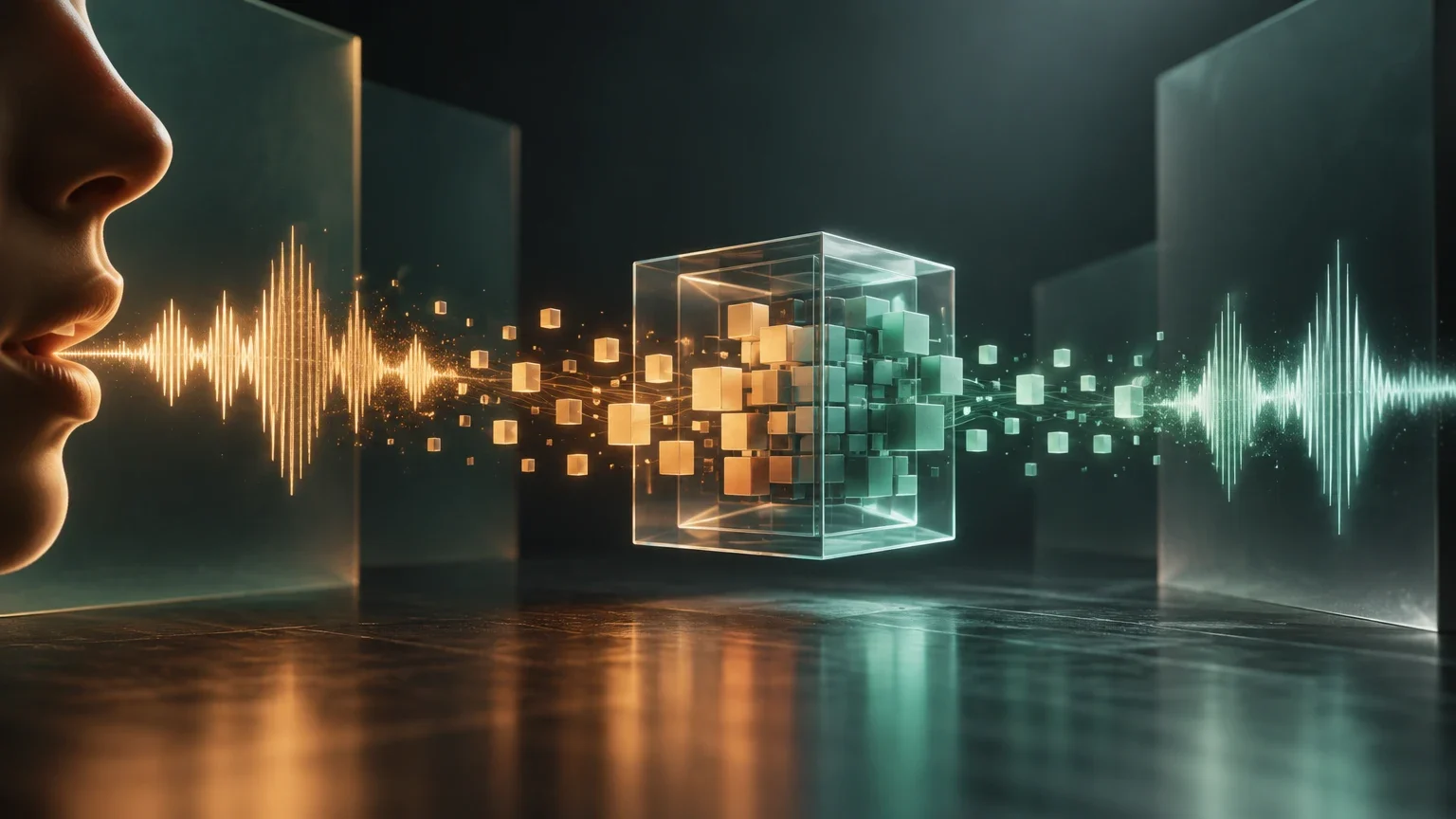
LiquidCodec is a neural speech codec that turns audio into discrete tokens and converts those tokens back into audio. Liquid AI has published BF16 weights in an official repository. The model is designed for mono speech at 24 kHz and supports streaming encoding and decoding.
The model card describes LiquidCodec as the audio tokenizer behind LFM3-Audio-2B and LFM3-Omni-2B. It can also be loaded separately with Transformers using custom code included in the repository. That compatibility does not mean the codec can turn text into speech on its own: it reconstructs speech from audio tokens and is not a complete text-to-speech system.
How it works and how large it is
The model has approximately 74 million parameters and a symmetric causal architecture: its encoder and decoder use blocks based on LFM3. The model card specifies speech at 24 kHz, frames at 12.5 Hz, and twelve tokens per frame, at an approximate bitrate of 1.65 kbps.
Its grouped finite scalar quantization, or GFSQ, divides features into groups and quantizes each group independently. Each group produces a token. Unlike a chain of codebooks with sequential dependencies, this design allows the tokens for a frame to be predicted in parallel. That mechanism can make parallel generation easier, but it does not by itself guarantee more faithful reconstruction or more natural synthesis.
Liquid AI describes both the encoder and decoder as fully causal, a property compatible with frame-by-frame processing and streaming. The decoder predicts spectral coefficients directly rather than relying on a series of upsampling stages with learned transposed convolutions. These are architectural choices; their practical effects depend on the device, implementation, and task.
Published specifications
| Property | Specification |
|---|---|
| Input and output | Mono speech at 24 kHz |
| Frame rate | 12.5 Hz |
| Tokens per frame | 12 |
| Approximate bitrate | 1.65 kbps |
| Parameters | Approximately 74 million |
| Repository weights | BF16 |
What the performance and quality tests show
Liquid AI reports that LiquidCodec encodes at about 361 times real time and decodes at about 87 times real time, measured in FP32 on a single CPU thread on an Apple M4 Max. The RTF metric divides processing time by audio duration; a lower value means faster processing. These figures are not equivalent to the latency of a complete application, and they have not been independently reproduced in the material cited here.
For English speech reconstruction, the company reports a ViSQOL score of 4.319 for LiquidCodec BF16 on LibriSpeech test-clean. The test compares reconstructed audio with the original; it does not measure the quality of speech generated from text. The result applies to that evaluation set and configuration, not to an overall average across languages or use cases.
The model card also reports comparisons across eight reconstruction and TTS test sets. In its tests, LiquidCodec achieved the highest ViSQOL scores and lowest mel distance on all eight reconstruction sets; in TTS, models trained on its tokens achieved the highest UTMOSv2 scores on all eight sets. These are results published by Liquid AI. The described TTS methodology controls the data, architecture, and compute used in the experiment, but the results are not a guarantee for other models, voices, languages, or conditions.
How to interpret three published results
| Result | Configuration | What it supports |
|---|---|---|
| Encoding: RTF 0.0028 | FP32, one CPU thread, Apple M4 Max | Encoder speed in this test; lower RTF is faster. |
| Decoding: RTF 0.0115 | FP32, one CPU thread, Apple M4 Max | Decoder speed in this test; not the end-to-end latency of an application. |
| ViSQOL: 4.319 | BF16 reconstruction on LibriSpeech test-clean, English | Reconstruction score for this test set; not a TTS measure or a result for every language. |
Access, formats, and license
The repository provides BF16 weights and supports loading through Transformers with custom code. Its documentation shows how to encode a waveform into tokens and decode them to reconstruct audio. Because loading can run code from the repository, review the implementation and pin a specific revision before using it in a work environment.
The Q4_0, Q4_K_M, and Q8_0 quantized decoder versions are not published as separate checkpoints in that repository. Liquid AI says they are included in GGUF distributions of LFM3-Audio-2B and LFM3-Omni-2B for local inference with llama.cpp. So anyone specifically looking for a standalone quantized decoder will not find those files in the LiquidCodec model card.
The weights are under the LFM Open License v1.0, not Apache 2.0. The license conditions commercial use by entities whose annual revenue exceeds a threshold of 10 million US dollars: that commercial use is not covered by the authorization granted under the agreement. The license specifies an exception for qualified nonprofit organizations using the work for non-commercial or research purposes. Read the terms that apply to your use and distribution before deploying or redistributing the model.
The model card does not publish a hosted API price. Local use requires compute resources, but costs depend on hardware, audio volume, configuration, and system operation; the performance figures do not establish a cost per minute.
Checks before integration
- 01Determine whether you need the repository’s BF16 codec or a quantized decoder included in a GGUF distribution.
- 02Review the custom code before loading the model and pin the revision you plan to use.
- 03Confirm that your use case involves speech: quality on music, singing, and environmental sounds has not been evaluated.
- 04Read the LFM Open License v1.0 and confirm that your commercial use and redistribution comply with its terms.
- 05Measure speed and quality on the hardware, language, and conditions of your own application.
Limits and practical decisions
LiquidCodec was trained and evaluated on speech. Its performance on music, singing, and environmental sounds has not been evaluated, so the published metrics do not justify assuming equivalent quality for those kinds of audio. Nor does multilingual training data alone establish that the model delivers the same quality in every language: scores depend on the specific test sets and tasks.
To decide whether it fits your needs, separate three questions. First, do the input format, sample rate, and token stream suit your audio pipeline? Second, does the compute cost measured on your hardware meet your streaming requirements? Third, does the reconstruction or TTS system you build reach the quality you need? The model card’s figures can help guide those tests, but they do not replace them.
Q4_0 quantization is another deployment option, not a universal quality guarantee. Liquid AI reports minimal loss in its comparisons, but that result applies to its evaluation and configuration. Repeat the comparison with the voices, languages, and devices you expect to use, especially if even a small quality difference matters to your product.
LiquidCodec’s practical contribution is a compact speech tokenizer with causal streaming and locally accessible BF16 weights. Its published tests point to high speed and strong reconstruction and TTS results on the test sets evaluated. The repository model card does not establish the announcement date or the initial effective availability date, and the cited documentation does not publish a hosted API price.
Keep exploring
Corrections and transparency
If you spot incorrect or outdated information, send us a correction with the page and source we should review.
Submit a correction