What the Exact Model Does
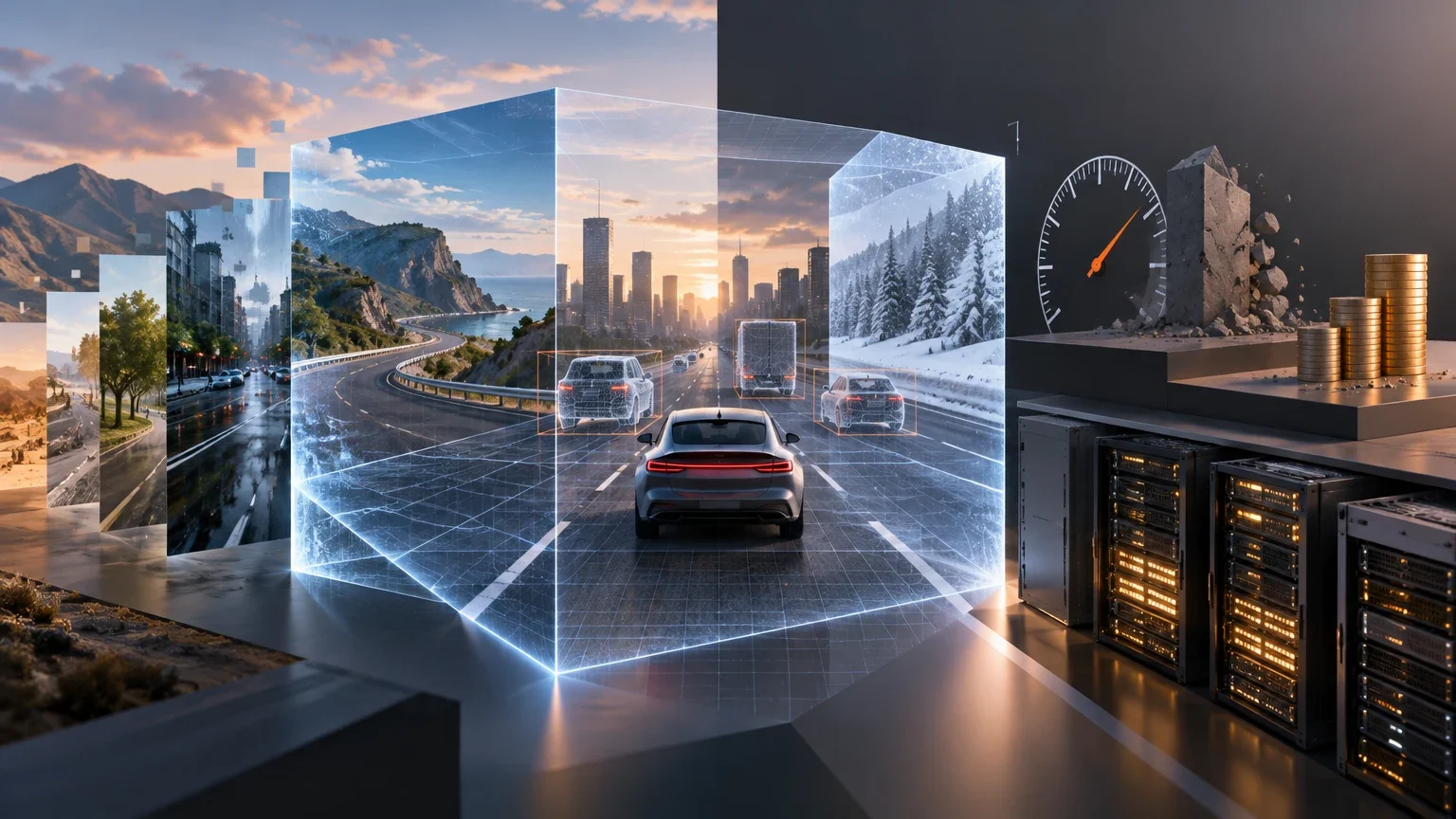
Cosmos3-Nano-Sim-Auto is a specific variant of NVIDIA's Cosmos3 family, released on October 20, 2026. Unlike the base Cosmos3-Nano model, which is a bidirectional generator, Sim-Auto is a distilled causal version designed for closed-loop simulation. This means the model can process input sequentially and generate the next world observation in real-time or near-real-time, a critical capability for evaluating autonomous driving policies.
The model operates as a physical world simulator for autonomous vehicles. It accepts descriptive text, World Scenario Map (WSM) controls that define scene structure (signs, lanes, objects), and optionally LiDAR data as input. As output, it generates synchronized videos from up to 11 cameras (including standard and fisheye lenses) and corresponding LiDAR observations. This multi-sensor synchronization is its main differentiator compared to conventional video generators.
The causal distillation process that transforms the bidirectional base model into the Sim-Auto variant is fundamental to its operational logic. By converting the architecture to a causal structure, the model loses the ability to look ahead in the sequence but gains the capacity to react to immediate inputs, which is essential for closed-loop interactions. This architectural shift ensures that the generation of the next frame depends strictly on the previous observations and the current control signals, mimicking the temporal causality of real-world driving environments where future events are not known in advance.
The integration of World Scenario Map controls provides a structured interface for defining the static and dynamic elements of the driving environment. These controls allow users to specify lane geometries, traffic signs, and object positions with precision, ensuring that the generated video adheres to the intended scenario structure. This level of control is particularly useful for creating reproducible test cases where specific traffic conditions need to be isolated and evaluated, providing a consistent baseline for comparing different driving policies or perception models.
Cosmos3 Nano Variants Comparison
Key differences between the base variant, the transfer variant, and the causal simulation variant.
| Feature | Cosmos3-Nano (Base) | Cosmos3-Nano-Transfer-Auto | Cosmos3-Nano-Sim-Auto |
|---|---|---|---|
| Architecture | Bidirectional | Bidirectional | Causal (Distilled) |
| Primary Use | General Generation | Batch Synthetic Data | Closed-Loop Simulation |
| LiDAR Output | Not Native | Yes | Yes |
| Control Capability | Limited | Static | Dynamic (Loop) |
Capabilities and Task Examples
The core capability of Sim-Auto is the generation of temporally coherent driving scenarios. Unlike creative video models that prioritize aesthetics, this model prioritizes physical plausibility and geometric consistency across cameras. For example, if a scenario is defined with a pedestrian crossing the street, the model must maintain the pedestrian's position coherently across all camera views and in the LiDAR point cloud throughout the sequence.
A practical use case is the evaluation of driving policies under adverse conditions. A team can generate thousands of variations of the same scenario (lighting changes, rain, fog) while keeping the scene structure constant via WSM controls. This allows testing the robustness of the vehicle's perception model without the need to drive in actual dangerous conditions.
The emphasis on geometric consistency across multiple camera views addresses a common challenge in multi-view video generation. In real-world autonomous driving systems, sensors are mounted at different angles and distances, leading to varying perspectives of the same scene. Sim-Auto is designed to maintain spatial coherence, ensuring that objects appear in the correct relative positions across all camera feeds. This consistency is crucial for downstream tasks that rely on multi-sensor fusion, such as 3D object detection and tracking, where discrepancies between camera views can lead to significant errors in the vehicle's understanding of its surroundings.
The ability to generate variations of a scenario while keeping the scene structure constant via WSM controls enables systematic testing of perception robustness. By altering environmental factors like lighting, weather, or sensor noise while maintaining the underlying traffic layout, teams can assess how well a driving policy generalizes across different conditions. This approach allows for the identification of failure modes that might not be apparent in a single, static test case, providing a more comprehensive evaluation of the system's reliability and safety margins.
Published Benchmarks and Methodology
NVIDIA has published quality metrics for Sim-Auto in its Hugging Face model card. It is crucial to distinguish these metrics from those of the Transfer-Auto variant, as they use different inference configurations (Sim-Auto uses guidance 1, while Transfer-Auto uses guidance 3). Additionally, evaluation prompts may vary, making direct comparison difficult without normalizing conditions.
The main metrics are FID (Fréchet Inception Distance) for image quality and FVD (Fréchet Video Distance) for temporal coherence. Lower values indicate better quality. According to official documentation, Sim-Auto achieves an FID of 48.6 in text-to-video (T2V) generation and 33.6 in image-to-video (I2V). These numbers are promising for simulation but must be interpreted with caution: a good visual quality metric does not guarantee the physical accuracy of traffic interactions.
The distinction between FID and FVD metrics highlights the dual focus of the model's evaluation on both visual fidelity and temporal stability. While FID measures the quality of individual frames by comparing their distribution to real-world data, FVD assesses the coherence of the entire video sequence. A low FVD score indicates that the generated video maintains consistent motion and object behavior over time, which is critical for simulation tasks where the evolution of the scene must be physically plausible. This combination of metrics provides a more holistic view of the model's performance than either metric alone.
The use of guidance 1 for Sim-Auto, as opposed to guidance 3 for Transfer-Auto, reflects the different optimization goals of the two variants. Lower guidance values typically result in more diverse and less constrained generations, which is suitable for simulation where the model needs to explore a range of possible outcomes. In contrast, higher guidance values in Transfer-Auto may prioritize adherence to specific input conditions, making it more suitable for batch generation of synthetic data where consistency with the input prompt is paramount. This difference in configuration underscores the importance of understanding the specific use case when interpreting benchmark results.
Quality Metrics Published by NVIDIA
Results of Cosmos3-Nano-Sim-Auto on the driving evaluation set. Lower is better for FID and FVD.
| Task | Configuration | FID (↓) | FVD-I3D (↓) |
|---|---|---|---|
| Text-to-Video (T2V) | Guidance 1 | 48.6 | 480 |
| Image-to-Video (I2V) | Guidance 1 | 33.6 | 325 |
Pricing and Deployment Requirements
Cosmos3-Nano-Sim-Auto is a 16B parameter model available under the OpenMDW 1.1 license, which permits commercial use. There is no NVIDIA-managed API with per-token pricing for this specific variant; deployment requires self-hosted infrastructure. This means the cost is not a subscription fee, but the cost of compute (GPU) and the engineering required to maintain the service.
In terms of hardware, the model requires high-end GPUs. Based on the Nano family architecture, hardware with at least 80GB of VRAM (such as H100 or RTX PRO 6000) is recommended to run the reasoning and generation towers simultaneously. Inference performance varies depending on resolution and the number of cameras. For 720p with multiple views, generation time can be significant, making the cost per GPU hour the dominant economic factor.
The requirement for self-hosted infrastructure implies a significant initial investment in hardware and engineering resources. Unlike cloud-based APIs that abstract away the complexity of deployment, self-hosting Sim-Auto demands expertise in managing GPU clusters, optimizing inference pipelines, and ensuring the stability of the service. This approach offers greater control over the deployment environment and data privacy, but it also shifts the burden of maintenance and scaling to the user. Organizations must carefully evaluate their internal capabilities and resource availability before committing to this deployment model.
The linear scaling of infrastructure costs with scene complexity is a key economic consideration for large-scale simulation projects. As the number of cameras, resolution, and sequence length increase, the computational load grows proportionally, leading to higher GPU utilization and energy consumption. This relationship necessitates a strategic approach to resource allocation, where teams must balance the need for high-fidelity simulations with the budget constraints of their projects. Optimizing the trade-off between simulation quality and computational cost is essential for maintaining the long-term viability of autonomous driving evaluation pipelines.
Estimated Deployment Process
Key steps to integrate Sim-Auto into an evaluation pipeline.
- 01Provision GPU with 80GB+ VRAM (H100, B200, or equivalent).
- 02Download weights from Hugging Face accepting the OpenMDW 1.1 license.
- 03Configure the environment with vLLM-Omni or NVIDIA's Cosmos framework.
- 04Prepare WSM and LiDAR controls for test scenarios.
- 05Run inference and validate temporal synchronization of outputs.
Limitations, Safety, and Alternatives
The most critical limitation is that the model is not an exact physics simulator. It approximates physical laws but can produce errors in object permanence, collisions, or fluid dynamics. Therefore, it should not be used as the sole source of truth for certifying the safety of an autonomous vehicle. It must be complemented with traditional physics simulators (such as Isaac Sim or Genesis) for high-level validation.
Regarding safety, NVIDIA applies content filters and SynthID watermarking on visual outputs. However, numeric action arrays do not carry visual watermarks. Alternatives include using the Transfer-Auto variant for batch generation (faster for massive synthetic data but without closed-loop capability) or using pure physics simulators if geometric accuracy is more important than photorealistic fidelity.
The limitation regarding object permanence and collision dynamics highlights the gap between generative approximation and exact physical simulation. While Sim-Auto can produce visually convincing driving scenarios, it does not enforce strict physical laws, which can lead to subtle errors in how objects interact with each other or their environment. These errors, though often imperceptible to human observers, can have significant implications for the training and evaluation of autonomous driving systems that rely on accurate physical interactions. Therefore, Sim-Auto should be viewed as a complementary tool rather than a replacement for traditional physics-based simulators.
The application of SynthID watermarking to visual outputs serves as a measure of provenance and safety, helping to distinguish AI-generated content from real-world footage. However, the absence of watermarks on numeric action arrays poses a challenge for tracking the origin of non-visual data. This distinction is important for organizations that need to audit the data used in their training pipelines, as it highlights the need for additional measures to ensure the integrity and traceability of all data types generated by the model. Understanding these nuances is crucial for implementing robust data governance practices in autonomous driving development.
Practical Selection Criteria
The decision to use Sim-Auto depends on whether the need is to simulate in real-time or generate data in batches. If the goal is to evaluate a driving policy that reacts to what it sees, Sim-Auto is the correct option due to its causal nature. If the goal is simply to generate thousands of video clips to train a perception model, the Transfer-Auto variant might be more efficient in cost and speed, although it lacks closed-loop capability.
It is recommended to evaluate first with low resolutions (480p) and a reduced number of cameras to validate the pipeline before scaling to 720p and 11 cameras. Infrastructure costs scale linearly with scene complexity, so careful hardware planning is essential to maintain the economic viability of the project.
The recommendation to start with lower resolutions and fewer cameras is a practical strategy for validating the simulation pipeline before scaling up. This phased approach allows teams to identify and resolve technical issues, such as synchronization errors or control mapping problems, in a less resource-intensive environment. By ensuring that the core functionality works correctly at a lower fidelity, organizations can build confidence in the system's reliability before investing in the higher computational costs associated with high-resolution, multi-camera simulations. This iterative process helps to mitigate risks and optimize the overall efficiency of the evaluation workflow.
The decision to use Sim-Auto over other variants or traditional simulators should be guided by the specific requirements of the evaluation task. For tasks that demand real-time interaction and causal reasoning, Sim-Auto offers unique capabilities that are not available in bidirectional models or physics-based simulators. However, for tasks that prioritize geometric accuracy or require the generation of large datasets without the need for closed-loop interaction, other tools may be more appropriate. A thorough analysis of the trade-offs between fidelity, speed, and cost is essential for making an informed decision that aligns with the project's goals and constraints.
Decision Table: Which Variant to Use?
Quick guide to select the appropriate variant based on the use case.
| Use Case | Recommendation | Reason |
|---|---|---|
| Closed-loop policy evaluation | Sim-Auto | Causal capability to respond to actions in real-time. |
| Massive synthetic data generation | Transfer-Auto | Bidirectional generation more efficient for large batches. |
| Exact physics simulation | Traditional Simulator (Isaac/Genesis) | Superior physical accuracy compared to generative approximation. |
Keep exploring
Sources consulted
Corrections and transparency
If you spot incorrect or outdated information, send us a correction with the page and source we should review.
Submit a correction