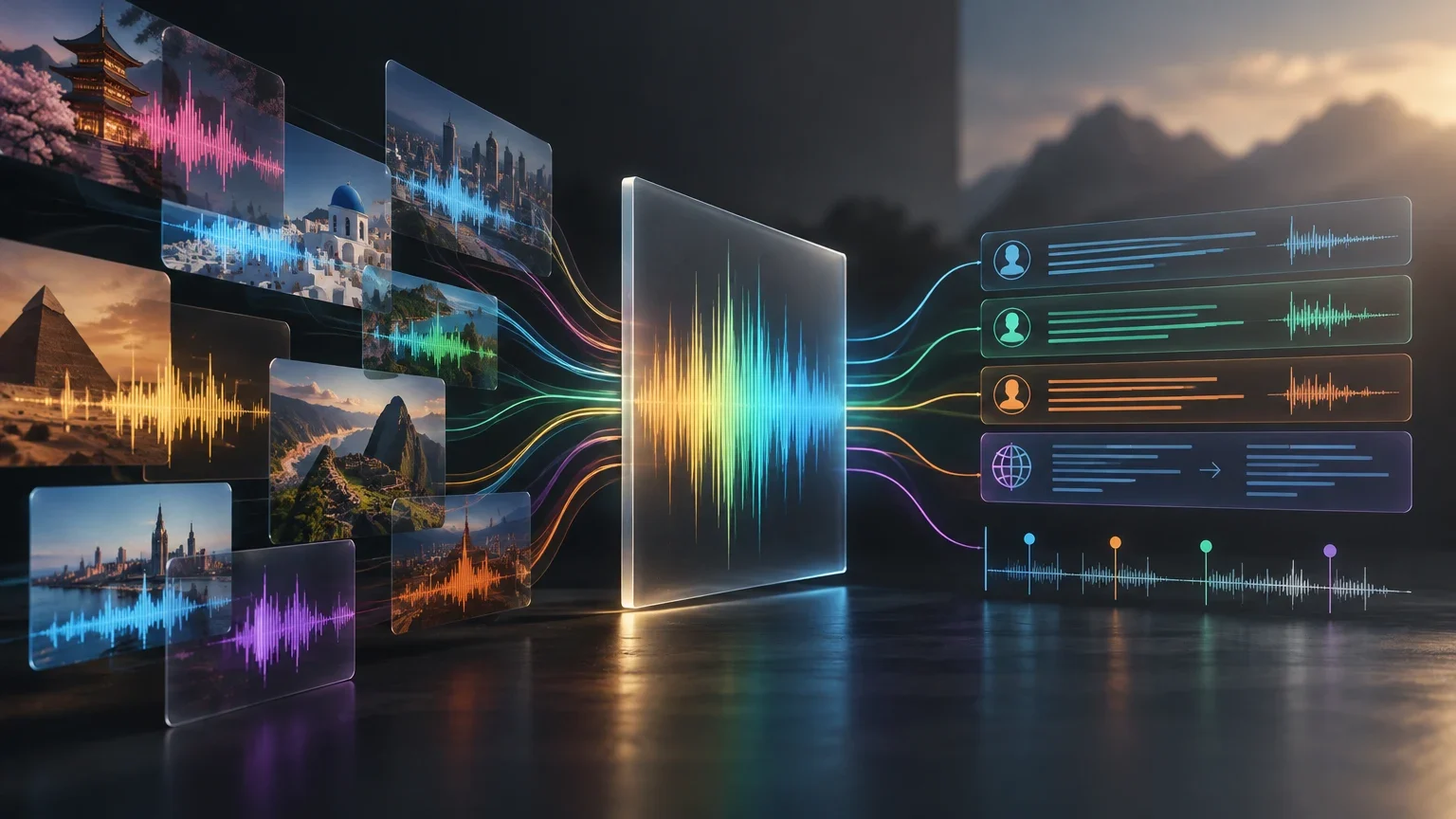
A model for transcribing recorded audio
NVIDIA introduced Nemotron 3.5 Transcribe as a speech recognition model that converts recorded audio into text. The company describes it as an open-weight model for developers building transcription, translation and conversation-processing tools. The available information points to uses such as meetings and dictation, but does not show that the model suits every professional setting or performs equally well in every language.
NVIDIA says the model supports transcription in up to 40 languages and translation from and into English for 31 languages. These are different capabilities: a language being supported for transcription does not necessarily mean it is available for every function. Language and task coverage may vary, so a multilingual application should be tested with its own recordings and the specific functions it intends to use.
Speakers, timestamps and instructions
The model is reported to identify up to eight speakers and generate word-level timestamps. Speaker identification, also called diarization, separates contributions from different voices within a recording; it does not establish the real-world identities of the people speaking. Speaker labels can help organize a conversation, but they are not proof of who a person is.
The model is also described as accepting instructions to guide the task, such as choosing between a verbatim transcript and a cleaned-up version, specifying specialist terms or requesting a translation. This can tailor output to different purposes, but it does not guarantee that the model will interpret every instruction correctly or preserve every nuance in the audio. For names, jargon and overlapping speech, the text should be checked against the recording.
Model size and active parameters
Published size figures need to be read with a distinction between total and active parameters. In a mixture-of-experts architecture, not every component necessarily activates at each inference step. The technical coverage consulted attributes about 30 billion total parameters and around 4 billion active parameters to NVIDIA; another architectural description includes the audio encoder and gives higher figures of 34 billion total and 4.3 billion active. These figures describe different component scopes and should not be confused with the size of a streaming variant.
The available information does not confirm, through primary documentation provided here, the hardware configuration Nemotron 3.5 Transcribe needs or its memory requirements for each numerical precision or deployment method. Parameter count alone is also insufficient to calculate runtime memory or speed: quantization, weight format, batch size and hardware all matter.
How to interpret model-size figures
These figures measure different things; none, on its own, determines practical performance or resource requirements.
| Measure | What it represents | What it cannot establish on its own |
|---|---|---|
| Total parameters | The combined size of the components included in a given description. | The exact memory required during inference. |
| Active parameters | The portion activated for an operation or token, as described by the architecture. | Actual speed on specific hardware. |
| Parameters in a variant | The size attributed to a particular version or component. | Whether that version has the same functions as the complete model. |
What the error-rate figures show
Word error rate, or WER, compares a transcript with a reference and counts substitutions, deletions and insertions. A lower figure means fewer errors under the conditions of that evaluation, but WER is not a universal measure of quality: results depend on the audio dataset, languages, noise, speech style and data-preparation rules.
The available figures come from comparisons and evaluations attributed to NVIDIA or from secondary tables consulted in October 2026. One secondary source reports an average of 5.33% on the Open ASR Leaderboard for English test audio; another gives 4.71% for an English result and 4.62% for a multilingual evaluation, attributed to different tests. Without primary documentation specifying the datasets, versions and calculation methods, these values should not be treated as one score or compared directly. Nor do they establish equivalent results for a language, accent or domain absent from each test.
A benchmark can guide comparisons under defined conditions. It cannot replace evaluation on recordings from actual use, especially when they include noise, specialist vocabulary, telephone audio or simultaneous speakers. A prominent score therefore does not guarantee that the model will outperform another option in a particular application.
A useful comparison for a specific use case
For an interpretable local evaluation, compare models under consistent conditions and retain results by audio category rather than relying only on an overall average.
- 01Choose representative recordings covering the languages, microphones, noise levels and vocabulary the application will encounter.
- 02Use the same recordings and reference text for each model, and document any normalization applied.
- 03Calculate WER by language or category, then review proper names, speaker assignment and timestamps separately.
- 04Also compare latency and resource use on the target hardware; do not assume an accuracy score determines these results.
Access, licensing and practical limitations
Secondary sources describe the model as open-weight and mention a specific license, but the corresponding primary documentation is not among the sources verified here. This material therefore cannot confirm the applicable license, the downloadable artifacts or the terms for commercial use. Before integrating the model into a product, developers should review the current official model card, its terms and the requirements of their intended environment.
Access to weights, if available under the expected terms, does not remove the need to assess privacy, security and quality. A transcript in a medical or business application may contain sensitive information, and errors can matter. Speaker labels do not identify people, while answers generated about a recording may differ from what was actually said; any use that affects important decisions requires appropriate safeguards and review.
NVIDIA’s proposal belongs to the broader field of speech systems, which includes automatic speech recognition and speech generation. The company’s institutional page explains these general components, but it is not a specific evaluation of Nemotron 3.5 Transcribe. When selecting a tool, it is important to distinguish audio transcription, translation, diarization and real-time processing: these functions are related but not interchangeable.
Checks to make before integrating a model
Evaluation should cover both the technical task and the conditions of deployment.
| Area | What to check |
|---|---|
| Coverage | Whether the intended version supports the specific language and function. |
| Quality | Word errors, proper names, specialist vocabulary and speaker assignment on your own audio. |
| Operation | Compatibility with expected hardware, latency, memory and processing volume. |
| Terms of use | Current license, origin of the weights and obligations that apply to the product. |
| Risk and privacy | Handling of sensitive recordings, human review and the consequences of errors in the intended setting. |
What can be concluded for now
Nemotron 3.5 Transcribe is presented as an option for transcribing recorded audio in multiple languages, with functions such as translation, timestamps and speaker identification. This combination may be useful to developers exploring a speech pipeline with several tasks, but announced features alone do not predict accuracy in a particular implementation.
The public figures available describe specific evaluations and do not, by themselves, provide a complete, reproducible comparison across all languages and scenarios. The primary details of the license, downloadable weights and required hardware are also not confirmed by the sources verified here. A sound decision distinguishes what the model is reported to do from what local testing demonstrates on the data and under the constraints of a particular application.
Open questions
- The verified sources do not include model-specific primary documentation confirming the current license and terms for using the weights.
- The available evidence does not establish which languages and tasks were validated in each evaluation or how diarization performs with overlapping voices.
- The WER percentages refer to differently described tests; the available sources do not allow their datasets, versions and methods to be aligned for a direct comparison.
- Minimum hardware, memory use and inference performance for specific configurations are not confirmed.
Keep exploring
Sources consulted
Corrections and transparency
If you spot incorrect or outdated information, send us a correction with the page and source we should review.
Submit a correction