What Cosmos3-Nano-Sim-Transfer Actually Does
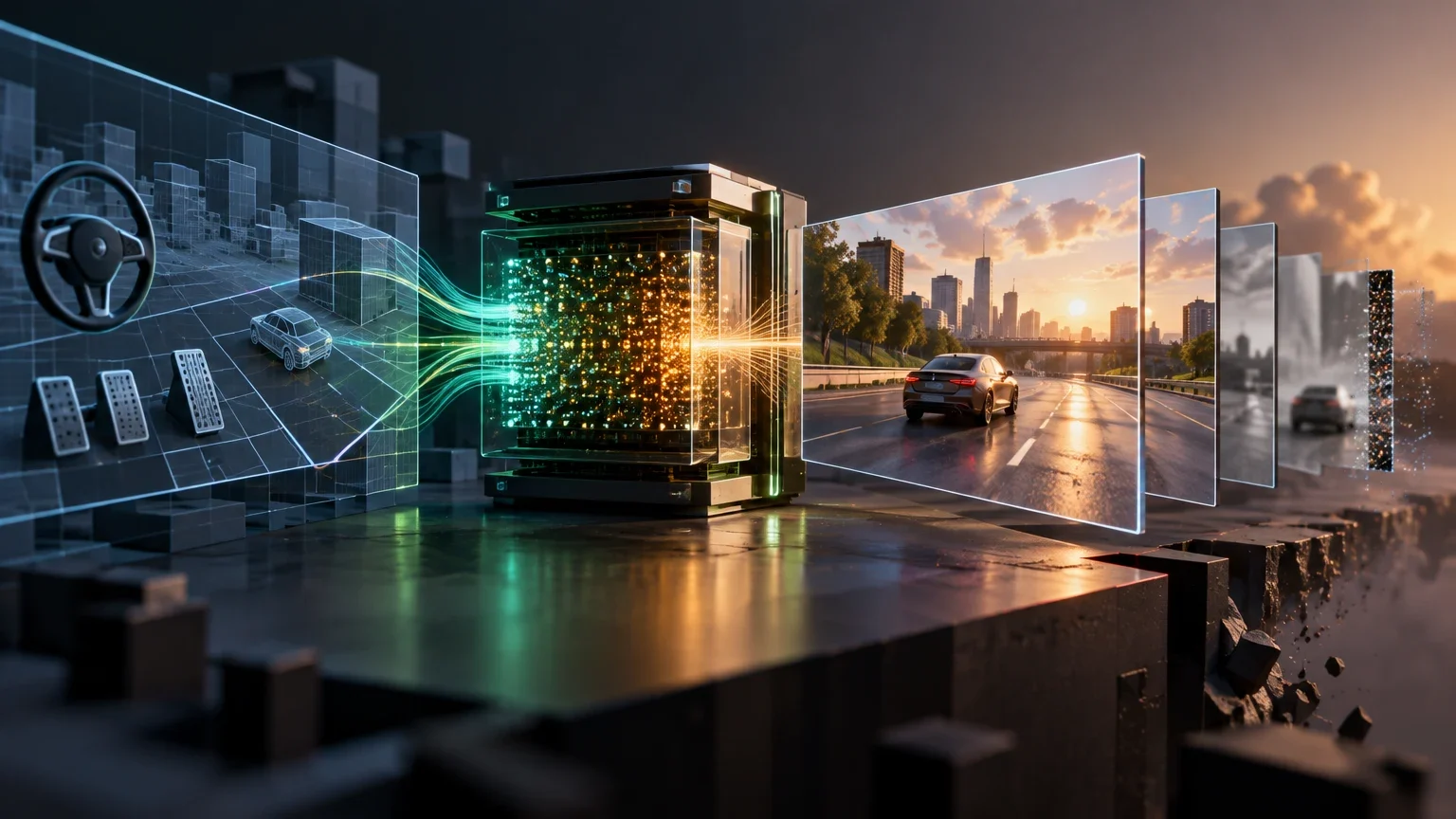
Cosmos3-Nano-Sim-Transfer is a physical AI foundation model developed by NVIDIA, released on October 20, 2026. Its primary function is not to simulate the physics of the world, but to generate visual appearance (RGB video) from structural controls provided by a classical simulator. It accepts text inputs and visual controls such as depth maps, segmentation, edges, or blur, and produces video sequences that mimic the photographic appearance of the simulated scene.
It is crucial to distinguish this model from a physics engine: geometry, object permanence, and physical laws remain the responsibility of the traditional simulator. The neural network provides the visual layer. Therefore, it is not a policy that generates actions for robots nor a safety certification tool, but a visual synthetic data generator for training and evaluating perception models.
The separation of concerns between the classical simulator and the neural network is fundamental to understanding the operational boundaries of this tool. The simulator provides the ground truth for the physical state of the world, including the precise positions, velocities, and interactions of objects over time. This structural data serves as the rigid skeleton upon which the model builds its visual representation. By relying on this external source for physical laws, the model avoids the computational burden and potential instability associated with learning physics from scratch, allowing it to focus exclusively on the complex task of rendering photorealistic textures, lighting, and material properties.
This architectural choice implies that the fidelity of the generated video is directly dependent on the quality and accuracy of the input controls. If the underlying simulator produces a depth map with noise or a segmentation mask with errors, the neural network will faithfully render these imperfections into the final video. Consequently, the model acts as a high-fidelity translator rather than a creator of physical reality. This distinction is critical for developers who might mistakenly assume that the model can correct or enhance the physical plausibility of a simulation; in reality, it merely amplifies the visual characteristics of the provided structural data, leaving the physical integrity entirely in the hands of the traditional simulation engine.
Architecture and Input/Output Modalities
The model uses a Transformer architecture with Mixture-of-Transformers (MoT), a technique that allows efficient handling of multiple modalities. The Nano variant has 16 billion trainable parameters, placing it between the Edge (4B) and Super (64B) versions of the Cosmos3 family.
Input modalities include text (description prompts), video (transfer controls or references), and action parameters in certain modes. The primary output is video in MP4 format with a VP9 track. For the Sim-Transfer variant, typical controls are depth maps, semantic segmentation, edges, and blur, which guide visual generation while maintaining coherence with the underlying physical structure.
The Mixture-of-Transformers architecture is specifically designed to handle the heterogeneous nature of the input modalities without requiring separate, specialized networks for each data type. By integrating text, video controls, and action parameters into a unified processing framework, the model can learn complex cross-modal correlations. For instance, it can understand how a textual description of a 'shiny metal surface' should interact with a depth map indicating a curved object to produce the correct specular highlights in the output video. This unified approach ensures that the visual generation remains coherent across different types of control signals, preventing disjointed or inconsistent visual artifacts that might arise from processing modalities in isolation.
The placement of the Nano variant with 16 billion parameters within the Cosmos3 family represents a strategic balance between computational efficiency and visual quality. It is large enough to capture intricate visual details and complex lighting scenarios that smaller models might miss, yet small enough to be deployed on standard high-performance GPU hardware without requiring the extreme memory and processing power needed for the Super variant. This makes it a practical choice for teams that need high-quality synthetic data generation but do not have access to the most massive computing clusters, providing a viable middle ground for industrial and research applications where resource constraints are a significant factor.
Cosmos3-Nano Key Modalities and Parameters
Summary of input and output capabilities according to NVIDIA's official documentation.
| Component | Detail |
|---|---|
| Architecture | Transformer MoT (Mixture-of-Transformers) |
| Parameters | 16B (Nano) |
| Inputs | Text, Video (controls), Action parameters |
| Output | Video MP4 (VP9), Image JPEG |
| Resolutions | 256p, 480p, 720p (aspects 16:9, 1:1, etc.) |
Published Benchmarks and Evaluation Methodology
NVIDIA publishes results in the PAI-Bench-C benchmark, specifically in the TransferBench section. It is important to note that this data comes from the provider and has not been independently replicated by Inferama or verified third parties at the time of this analysis. The metrics include DOVER (technical video quality), mIoU (segmentation), and SI-RMSE (depth error).
The published values for this specific checkpoint are: DOVER of 10.175942, segmentation mIoU of 0.73776, and depth SI-RMSE of 0.619426. These metrics measure visual fidelity and coherence with input controls, but they do not guarantee the physical accuracy of the simulation. A high DOVER indicates a visually clean video, not that objects move according to Newton's laws.
The reliance on provider-published benchmarks introduces a layer of caution that must be considered when interpreting the performance metrics. Since the data has not been independently replicated by third parties, the reported values should be viewed as indicative rather than definitive proof of the model's capabilities in diverse real-world scenarios. The specific configuration of the test cases within the PAI-Bench-C benchmark, including the types of scenes, lighting conditions, and complexity of the structural controls, may not fully represent the variety of challenges encountered in actual deployment environments. Therefore, users should conduct their own preliminary evaluations to ensure that the model's performance aligns with their specific requirements before committing to large-scale data generation projects.
The metrics provided, such as DOVER and mIoU, offer a quantitative snapshot of visual quality and segmentation accuracy, but they do not capture the full spectrum of potential issues that may arise in temporal consistency or physical plausibility. A high score in these areas indicates that the model is effective at producing clean, well-segmented video frames, but it does not guarantee that the motion between frames is smooth or that the interactions between objects are physically logical. This gap between visual fidelity and physical accuracy is a key consideration for teams using the model to train perception systems, as the training data must not only look realistic but also behave in a way that reflects the true dynamics of the physical world to avoid introducing biases or errors into the downstream models.
TransferBench Metrics (PAI-Bench-C)
Values published by NVIDIA for Cosmos3-Nano-Sim-Transfer. Lower is better for SI-RMSE; higher is better for DOVER and mIoU.
| Metric | Value | Interpretation |
|---|---|---|
| DOVER | 10.175942 | Technical quality of generated video |
| Segmentation mIoU | 0.73776 | Semantic segmentation accuracy |
| Depth SI-RMSE | 0.619426 | Depth reconstruction error |
Deployment Requirements and Infrastructure Costs
The model is distributed under the OpenMDW-1.1 license, which allows commercial and non-commercial use, provided the license terms are met. Weights are publicly available on Hugging Face and code on GitHub. However, there is no direct API fee published by NVIDIA for this specific checkpoint in the verified primary sources; the cost falls on the user's own infrastructure.
For inference, NVIDIA GPU hardware is required, specifically Blackwell (GB200) or Hopper (H100, H200, H20) architectures. Performance varies drastically depending on resolution, frame count, and parallelism. For example, generating 201 frames at 480p on a single H100 GPU can take several minutes, while in multi-GPU configurations the time is significantly reduced. The cost must budget for GPU, memory, storage, and operation, as free weights do not eliminate computational cost.
The absence of a direct API fee shifts the financial burden entirely to the user's infrastructure management, requiring a careful assessment of the total cost of ownership. While the weights are freely available, the operational costs associated with running the model on high-end NVIDIA GPUs can be significant, particularly for large-scale data generation tasks. Teams must account for the electricity consumption, cooling requirements, and maintenance of the hardware, in addition to the initial capital expenditure for the GPUs themselves. This cost structure favors organizations that already have established GPU clusters or those that can leverage cloud services with competitive pricing for high-performance computing, making the model more accessible to larger enterprises and research institutions than to smaller teams with limited budgets.
The variability in performance based on resolution, frame count, and parallelism adds another layer of complexity to the deployment planning. Optimizing the inference pipeline to maximize throughput while maintaining acceptable latency is a non-trivial task that requires expertise in both machine learning and systems engineering. Teams may need to experiment with different batch sizes, parallelism strategies, and hardware configurations to find the optimal balance between speed and resource utilization. This iterative process of tuning and optimization can be time-consuming and resource-intensive, further emphasizing the need for a thorough cost-benefit analysis before committing to the use of this model for production-level data generation.
Local Deployment Process
Basic steps to run the model on own infrastructure.
- 01Download weights from Hugging Face (nvidia/Cosmos3-Nano-Sim-Transfer).
- 02Set up an environment with PyTorch and vLLM-Omni compatible with NVIDIA GPU.
- 03Start the inference server specifying the appropriate pipeline class.
- 04Send requests with simulation controls (depth, segmentation) and text prompts.
- 05Decode the base64 response into an MP4 file for further use.
Limitations, Safety, and Alternatives
The main limitation is the lack of guaranteed physical accuracy. Generation may present temporal inconsistencies, unstable motion, or imprecise physical interactions. NVIDIA explicitly warns that the model is not designed for safety-critical applications where failure could cause injury or catastrophic damage. It requires independent validation and system-level safety analysis.
Regarding safety, input media undergoes mandatory screening for child sexual abuse material (CSAM) and other content safeguards. Visual outputs carry a SynthID watermark, although numerical action arrays are not visually watermarked. As an alternative, the Cosmos3-Nano-Transfer-Auto variant specializes in autonomous driving with LiDAR, while Sim-Transfer focuses on general robotics and industrial simulation.
The explicit warning against using the model for safety-critical applications underscores the importance of maintaining a clear distinction between visual simulation and physical reality. In domains such as autonomous driving or industrial robotics, where decisions are made based on sensor data and physical interactions, the potential for temporal inconsistencies or imprecise physical interactions in the generated video could lead to catastrophic failures if the model's output is used directly for control. Therefore, any system that incorporates this model must include robust validation mechanisms that independently verify the physical plausibility of the generated data, ensuring that the visual output does not introduce errors that could compromise the safety of the system or its operators.
The inclusion of content safeguards, such as the mandatory screening for CSAM and the application of SynthID watermarks, reflects a commitment to responsible AI development and the prevention of misuse. These measures help to ensure that the model is used for legitimate purposes and that the generated content can be traced back to its source. However, the fact that numerical action arrays are not visually watermarked highlights a potential gap in the traceability of certain types of output, which may require additional measures to ensure accountability and transparency in the use of the model's outputs. Teams should be aware of these nuances and implement their own tracking and logging systems to maintain a clear audit trail of the data generated and its subsequent use.
Practical Criteria for Model Selection
The decision to use Cosmos3-Nano-Sim-Transfer depends on whether you need to generate large-scale visual synthetic data to train perception models, and whether you have the necessary GPU infrastructure. If the goal is to simulate precise physics for real-time control, this model is not suitable; it should be used as a visual complement to a classical physical simulator.
For teams with limited resources, the Edge (4B) variant might be more viable, albeit with lower quality. For autonomous driving applications with LiDAR sensors, the Transfer-Auto variant is more specific. The choice should be based on the balance between visual quality, computational cost, and the need for physical coherence, always maintaining human and technical validation of the results.
The decision to select Cosmos3-Nano-Sim-Transfer should be guided by a clear understanding of the specific needs of the project and the available resources. For teams focused on generating large-scale synthetic data to train perception models, the model offers a powerful tool for creating realistic visual scenarios that can enhance the robustness and generalization of downstream models. However, for projects that require precise physical simulation for real-time control, the model is not a suitable choice, as it does not provide the necessary guarantees of physical accuracy. In such cases, it is more appropriate to use the model as a visual complement to a classical physical simulator, leveraging its ability to generate high-fidelity visual data while relying on the simulator for the underlying physical dynamics.
The availability of different variants within the Cosmos3 family, such as the Edge and Transfer-Auto, provides flexibility for teams with varying requirements and resource constraints. The Edge variant may be a more viable option for teams with limited computational resources, offering a lower-cost solution for basic visual generation tasks, while the Transfer-Auto variant is better suited for applications involving autonomous driving with LiDAR sensors. The choice between these variants should be based on a careful evaluation of the trade-offs between visual quality, computational cost, and the need for physical coherence, ensuring that the selected model aligns with the specific goals and constraints of the project. Maintaining human and technical validation of the results is essential to ensure that the generated data meets the required standards of quality and accuracy.
Decision Table: When to Use Sim-Transfer?
Quick guide to determine the suitability of the model according to the use case.
| Use Case | Suitability | Reason |
|---|---|---|
| Generate synthetic data to train computer vision | High | Generates realistic RGB video from structural controls. |
| Precise physical simulation for robot control | Low | Not a physics engine; physical accuracy is not guaranteed. |
| Autonomous driving with LiDAR | Medium/Low | Use Transfer-Auto for LiDAR; Sim-Transfer is more generalist. |
| Deployment on CPU or low-cost GPU | Low | Requires high-performance NVIDIA GPU (Hopper/Blackwell). |
Open questions
- A direct NVIDIA API fee for this specific checkpoint has not been verified; costs are for own infrastructure.
- PAI-Bench-C benchmarks are from the provider and have not been independently replicated.
- Exact performance on specific hardware not provided by the user may vary depending on parallelism configuration and system load.
Keep exploring
Sources consulted
Corrections and transparency
If you spot incorrect or outdated information, send us a correction with the page and source we should review.
Submit a correction