Model Identity and Purpose
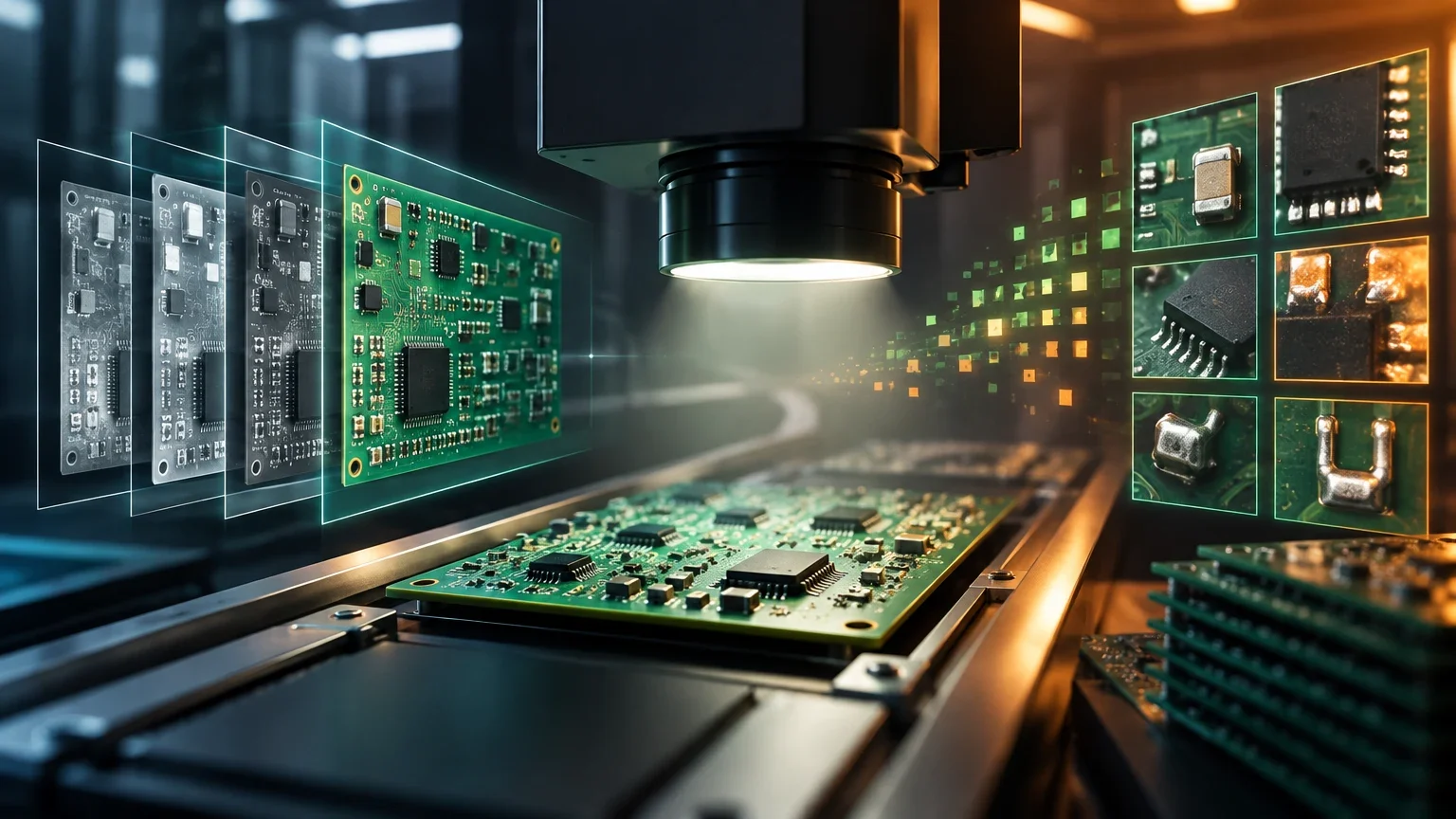
NVIDIA has released version 1.0.0 of CDF Sim2Real SMT Solderlight, an image editing model designed specifically for the data augmentation pipeline of printed circuit board (PCB) inspection. Its primary function is to transform synthetic crops of electronic components, generated via Omniverse renderings, into a lighting style that simulates the conditions of automated optical inspection (AOI).
Unlike generic text-to-image generation models, this model operates with a fixed English instruction that describes the style and light transformation. The user does not control the semantic content of the image through free prompts; instead, the model focuses on visual domain transfer (sim-to-real) to improve the robustness of downstream defect classifiers.
The practical boundary between image editing and inspection is central to understanding the model’s role. It changes the appearance of synthetic component crops so that their lighting style is closer to the target inspection conditions; it does not decide whether a board or component passes quality requirements. Any benefit therefore depends on how the transformed images are used by a separately trained classifier and on whether the transformation preserves the visual evidence that classifier needs.
The fixed instruction also defines a deliberately narrow interaction pattern. Rather than asking the model to create different component content or to follow arbitrary semantic directions, the pipeline applies the specified lighting and style transformation to an input image. This makes the intended use more controlled, but it does not by itself establish that every output is faithful to its input or appropriate for training. Those properties still require evaluation on the images and workflow in which the model will be used.
Architecture and Technical Specifications
The model derives from Qwen-Image-Edit, but the distributed package is not an independent LoRA adapter; it is a complete pipeline with fused weights. According to the official documentation, the architecture estimates approximately 20 billion parameters in total, of which roughly 170 million correspond to the LoRA weights trained and fused for this specific task.
The input consists of an RGB image of a PCB component and the fixed instruction. The output is an RGB PNG image. It is crucial to note that training was performed with a target area of 262,144 pixels, which equates to 512 × 512 pixel square crops (0.262 megapixels). Using resolutions significantly different from this may degrade the quality of the applied style.
The distinction between a fused package and a standalone LoRA adapter matters when interpreting what is being distributed. The LoRA weights are described as having been incorporated into the model pipeline, so deployment should be understood as running the packaged edited-image model rather than treating the task-specific weights as a separate component that can simply be attached to an arbitrary base installation. The approximate parameter counts are architectural descriptions, not a direct measurement of inference speed, memory use, or total deployment cost.
The specified 512 × 512 target area provides a concrete reference point for preparing inputs, while the warning about substantially different resolutions remains qualitative: the documentation does not quantify how much quality changes at other sizes. Teams should therefore avoid assuming that resizing alone guarantees equivalent results. Keeping crop preparation consistent with the training area makes evaluation easier to interpret, but the output still needs visual checking for the particular component crops being processed.
The input and output formats describe an image-to-image workflow: an RGB component image is supplied with the fixed instruction, and the result is an RGB PNG. This format description does not establish that the transformed image retains every relevant detail. The fact that both images are RGB, or that the output is saved as PNG, should not be mistaken for evidence of geometric or defect preservation; those are separate properties to assess during validation.
Key Model Specifications
Technical parameters
| Parameter | Value / Description |
|---|---|
| Version | 1.0.0 |
| Release Date | October 20, 2026 |
| Base | Qwen-Image-Edit (fused weights) |
| Total Parameters | ~20B (estimated) |
| LoRA Parameters | ~170M (fused) |
| Training Area | 262,144 pixels (512x512) |
| Modalities | Input: Image + Fixed Text; Output: Image |
Training and Evaluation Methodology
NVIDIA indicates that training was conducted with 364 data pairs. The published evaluation is qualitative and visual, with no documented independent validation or test partition in the public documentation. Human reference photographs are not packaged in the repository, which limits the ability to directly compare the output with real factory images without access to proprietary data.
No numerical industrial quality scores (such as F1-score or defect detection precision) are published for this specific model. Therefore, benchmarks from the base Qwen-Image-Edit model cannot be inherited, as the LoRA fine-tuning significantly modifies the model's behavior for the specific task of PCB lighting.
The 364 reported training pairs provide useful context for the scope of the training material, but the count alone does not show how broadly the model covers lighting conditions or component appearances. The public evaluation is described as visual and qualitative; no independent validation or test partition is documented. The description therefore does not establish how consistently the transformation generalizes beyond the paired examples used for training.
The absence of packaged human reference photographs also constrains what can be checked from the repository alone. A team without access to its own suitable real images cannot directly determine how closely transformed synthetic crops correspond to the conditions it needs to represent. Even when such images are available, visual similarity should not be treated as a substitute for measuring whether component geometry remains intact or whether the transformation introduces marks that could be mistaken for defects.
No reported F1-score, defect-detection precision, or other numerical industrial measure is available for this task-specific model. That limits claims about downstream gains: a visually plausible lighting transformation does not demonstrate that a classifier trained with those images will improve. The base model’s benchmarks are not a substitute, because this package has been adapted for a narrower image-editing objective and its behavior may differ materially from the base model.
A useful evaluation should separate image-level review from classifier-level assessment. First inspect whether the transformation changes component shape or introduces apparent defects; then test the downstream inspector using separated training and test boards, and include human review as described in the recommended process. This can help distinguish a plausible-looking edit from an edit that is suitable for the intended training pipeline, without implying that the model has already passed industrial validation.
License, Costs, and Deployment
The model weights are publicly available under the OpenMDW 1.1 license. It is important to distinguish that the original Qwen-Image-Edit components retain the Apache 2.0 license, but the specific NVIDIA package is subject to the terms of OpenMDW 1.1, which must be reviewed for specific commercial uses.
There is no official API fee published by NVIDIA for this model. Deployment costs are assumed as self-hosted infrastructure: GPU, video memory, storage, and operation must be budgeted. Given that the model has ~20B parameters, high-performance hardware is required for inference, implying significant capital and operational costs for teams without GPU clusters.
The licensing distinction should be kept explicit when assessing deployment: the distributed NVIDIA package is identified as OpenMDW 1.1, while the underlying Qwen-Image-Edit components retain Apache 2.0. The latter does not replace the terms applicable to the specific package. Anyone considering commercial use should review the OpenMDW 1.1 terms for that intended use rather than infer permissions from the base model’s license alone.
No official API price is listed, so the described cost model is self-hosting rather than a published per-call service fee. The practical budget is not determined by the parameter count alone: GPU capacity, video memory, storage, operation, integration, and maintenance all contribute, and the actual amounts depend on the chosen hardware and configuration. The estimate of roughly 20 billion parameters signals a substantial inference requirement, but it is not a precise cost quotation or a guarantee that one fixed hardware setup will suit every deployment.
The deployment decision therefore has both a technical and an operational dimension. Sufficient GPU resources are needed to run inference, while the inspection workflow must also accommodate image preparation, the fixed instruction, output review, and downstream classifier validation. Because the model only produces modified images, these requirements should be considered alongside—not in place of—the existing inspection and quality-control stages.
Cost and Deployment Considerations
Factors to consider when integrating the model into self-hosted infrastructure.
| Element | Detail |
|---|---|
| License | OpenMDW 1.1 (verify commercial terms) |
| Official API | Not published; self-deployment |
| Hardware | High-performance GPU (recommended for 20B parameters) |
| Direct Cost | Self-hosted infrastructure (GPU, RAM, Storage) |
| Indirect Cost | Pipeline development, integration, and maintenance |
Limitations, Safety, and Bias
The official BIAS.md document confirms that the model operates exclusively on synthetic renders and machine-generated images of inanimate PCB components. There are no human subjects in the training or evaluation data, and no human attribute labels are used as a supervision signal. This eliminates demographic bias risks but does not guarantee the absence of technical biases related to real lighting variability not covered by the 364 training pairs.
Safety and privacy are addressed in specific documents (SAFETY.md, PRIVACY.md) included in the repository. Given that the model processes images of electronic components, privacy risks are minimal, but security risks are related to the integrity of the inspection pipeline: if the model introduces artifacts that mimic defects, it could generate false positives in the quality control system.
The absence of people from the described training and evaluation data limits the relevance of demographic-bias concerns for this particular image task. It does not establish that the model is free of all bias or error: technical variation in real lighting that is not represented among the 364 training pairs may still affect how well the transformation matches a team’s target images. The evidence supports a narrower conclusion about the data and supervision described, not a general assurance of unbiased performance.
The main safety concern stated for this workflow is the integrity of the images used by the inspection pipeline. If a transformation creates an artifact that resembles a defect, a downstream classifier could treat it as defect evidence and produce a false positive; if relevant visual detail is altered, the resulting image may also be unsuitable for training. These are risks to check, not documented outcomes that can be assumed to occur in every run.
For that reason, visual plausibility alone is insufficient as a production-readiness test. The stated warning is that the model has not been validated for real-time production-line use without exhaustive testing. Human review or a second-level stage remains necessary in the pipeline, especially when judging whether transformed examples preserve the information needed to identify actual defects.
Practical Selection Criteria
This model is suitable for industrial computer vision teams that need to augment the lighting diversity in their training datasets for PCB inspection. It is not suitable for teams seeking an 'out-of-the-box' defect detection solution, as the model only generates modified images and does not classify defects.
The decision to adopt this model should be based on the availability of sufficient GPU hardware, the ability to integrate the inference pipeline into the existing workflow, and the willingness to perform a rigorous evaluation of the generated image quality before using them to train classifiers.
Adoption is most relevant when a computer-vision team already has a PCB inspection workflow and wants to diversify the lighting style represented in training images. The model is not a standalone defect detector: it edits images but does not assign defect labels or make the final quality decision. Teams seeking an immediately deployable classifier would therefore need additional components and validation beyond this model’s stated function.
Before using generated images in classifier training, teams should decide whether they can support the full evaluation loop: prepare synthetic crops, run the fixed-instruction transformation, inspect outputs for changes to geometry or defect-like artifacts, and test the resulting classifier with human review. This is more than a check that inference runs successfully; it assesses whether the images are useful and safe enough for the intended downstream training purpose.
Hardware availability, workflow integration, and evaluation capacity are connected adoption criteria. A team may have access to a suitable GPU yet still lack the image-review process or test data needed to judge the transformation. Conversely, a rigorous review plan cannot remove the need to budget for inference infrastructure. The decision should account for both constraints while retaining the documented uncertainty about industrial performance and resolution effects.
Recommended Integration Process
Steps to integrate the model into an inspection pipeline.
- 011. Verify the OpenMDW 1.1 license for the intended commercial use.
- 022. Prepare GPU hardware with sufficient memory for the 20B parameters.
- 033. Implement the inference pipeline with the fixed instruction.
- 044. Generate a test set of images from synthetic renders.
- 055. Visually evaluate the quality of the style transformation.
- 066. Train a defect classifier with the augmented images.
- 077. Validate the classifier's performance with human review.
Keep exploring
Sources consulted
Corrections and transparency
If you spot incorrect or outdated information, send us a correction with the page and source we should review.
Submit a correction