One-sentence definition
Ability to process or generate more than one type of information, such as text, image, audio, or video.
Definition and concepts not to confuse
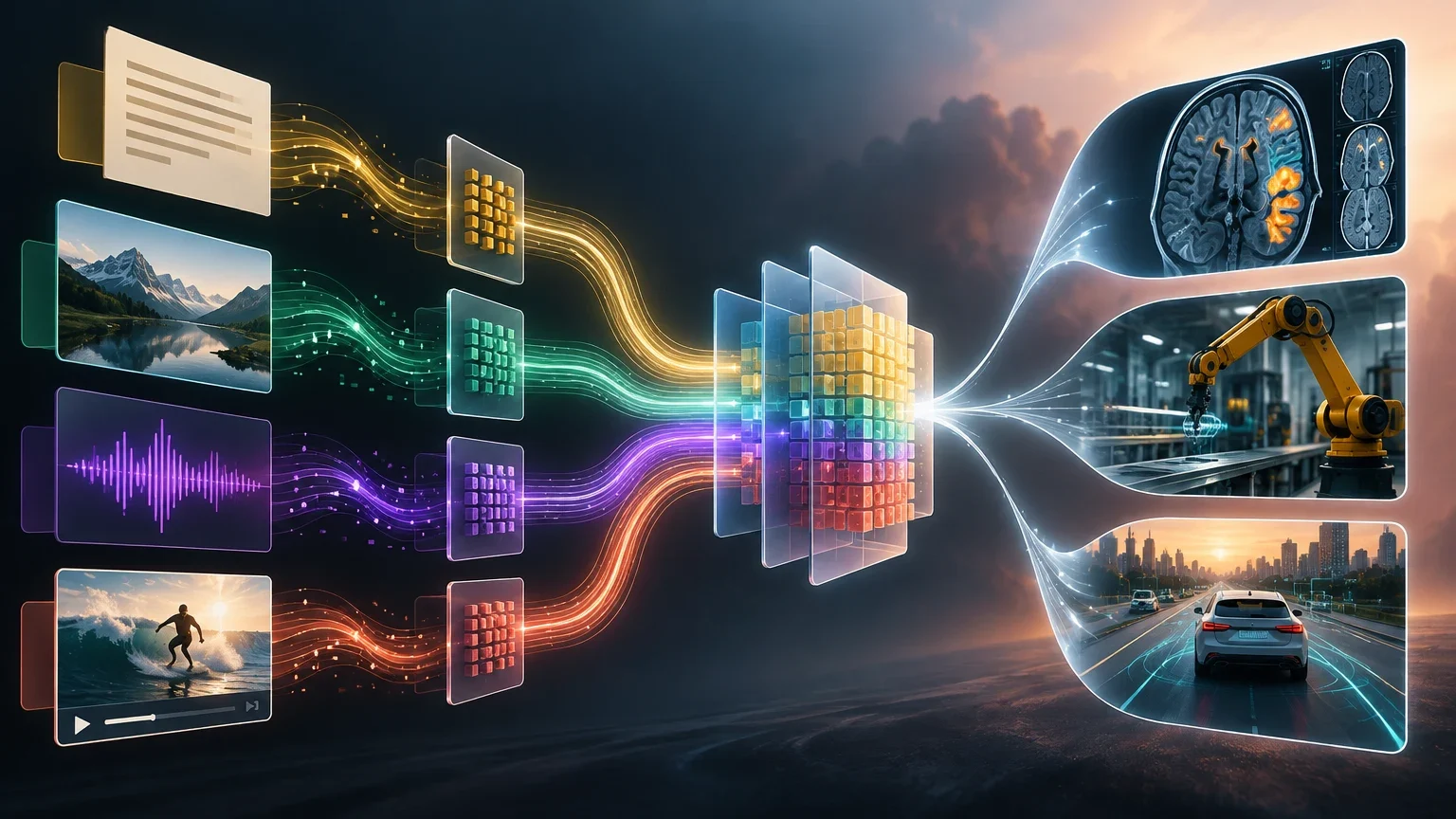
Multimodality is the ability of an AI system to process or generate more than one kind of information, or modality. Common modalities include text, images, audio, and video; some systems also use sensor readings or other structured data. A multimodal system can connect information across these inputs, rather than treating each one as an isolated task. For example, it may answer a question about an image, relate spoken words to a video scene, or generate a text description from visual input.
The term does not mean simply that a dataset contains different file formats. A folder might contain text documents and videos, but it is not meaningfully multimodal for a particular system unless the system can process and relate those inputs. Nor does multimodality guarantee better results: an additional input can be irrelevant, noisy, poorly aligned, or misleading. The key technical challenges are alignment—working out which parts of different inputs correspond—and fusion—deciding how to combine their information. These are distinct from transfer learning, which is the use of knowledge learned in one setting to improve performance in another. A system can use transfer learning without being multimodal, and a multimodal system may use transfer learning as part of its training.
It is also useful to distinguish multimodal data from multimodal learning and multimodal models. Multimodal data contains multiple modalities; multimodal learning refers to methods that learn from or relate those modalities; and a multimodal model is a system built to accept, process, or produce more than one modality. Capabilities vary: some models take an image and return text, while others can accept or generate several kinds of input and output. A model that handles multiple modalities does not necessarily combine every modality in every task.
Unimodal and multimodal systems compared
The distinction is about the information a system processes and how it relates that information—not simply the file formats stored nearby.
| Feature | Unimodal system | Multimodal system |
|---|---|---|
| Inputs | One primary modality, such as text alone | Two or more modalities, such as text and images |
| Data structure | Typically one representation type | Heterogeneous representations, such as tokens, pixels, or waveforms |
| Processing | Designed around a single input type | May require alignment and cross-modal interaction |
| Complexity | Often simpler to build and evaluate | May require more data handling, computation, and testing |
How multimodal processing works, step by step
There is no single architecture or pipeline used by every multimodal system. A common pattern, however, is to convert each input into a representation the model can process, make those representations compatible, relate or combine them, and then produce an output suited to the task. Some systems use separate encoders for each modality; others use a more unified design. The stages below are a useful conceptual guide, not a claim that every model performs them as distinct operations or in this exact order.
First, an encoder transforms raw input into features. Text may be split into tokens and represented as numerical vectors. An image encoder may represent visual patterns, patches, or regions; an audio encoder may convert a waveform into features that capture speech or other sounds. Video can be handled as a sequence of frames, sometimes paired with audio and timestamps. These representations preserve information the system may need later, but they are not perfect copies of the original input: preprocessing and encoding can lose detail.
Next, projection can map features from different encoders into compatible representations. A learned linear layer or another small network may adjust their dimensions or format so that the model can use them together. Projection does not, by itself, establish that the inputs are correctly aligned or semantically equivalent. It makes interaction possible; the model still has to learn or determine which information is relevant.
The system then combines or relates the representations. A simple approach is to concatenate vectors. More complex systems use attention: cross-attention lets elements from one modality, such as text tokens, draw on relevant elements from another, such as image features. Depending on the architecture, fusion can happen early, while inputs are being represented; at an intermediate stage; or later, after separate processing. A transformer or another model may then refine relationships within and across modalities.
Finally, a decoder or task-specific output layer produces a result. That might be a sentence describing an image, an answer to a question about a video, a classification label, or generated content in another modality. Training and fine-tuning shape the system’s behavior: paired examples can teach correspondences between images and captions, while instruction examples can teach it to respond to requests. The particular training data and objective determine what the model has learned; having multiple input types alone does not establish robust cross-modal reasoning.
A common multimodal processing pipeline
A simplified sequence for understanding how different inputs can become a task-specific result.
- 01Encode: Convert raw text, images, audio, or other inputs into features using representations appropriate to each modality.
- 02Project: Map features into compatible representations, when the architecture needs this step.
- 03Align and fuse: Relate corresponding information and combine features through concatenation, attention, or another method.
- 04Process: Refine within- and cross-modal relationships using the model’s learned layers.
- 05Decode: Produce the requested output, such as text, a classification, or generated media.
Three examples in different fields
Healthcare provides one example of why multiple inputs may matter. A research or clinical-support system might relate a medical image to a radiology report, a clinical note, or structured patient information. In a pathology workflow, a vision-language model could compare an image with text prompts describing features of interest. This illustrates a possible use of image-and-text processing; it does not establish that a model can make a diagnosis safely or replace clinical judgement. Any real clinical use requires validation for the intended population, task, and workflow, as well as appropriate oversight.
In manufacturing, a monitoring system could combine time-series sensor readings, inspection images, and maintenance notes. A vibration pattern might be considered alongside a visible defect and a record of previous repairs. The system could flag equipment for inspection or help rank cases for review. This is an illustrative workflow, not a reported performance result: whether combining these inputs improves maintenance decisions depends on data quality, timing, the equipment involved, and how the system is tested.
Autonomous and driver-assistance systems illustrate sensor fusion. Cameras provide visual information such as color and texture; radar and lidar can supply different measurements of distance or motion. Combining sensor streams may help a system interpret its surroundings, but no sensor or fusion method is infallible. Sensors can be obscured, affected by environmental conditions, miscalibrated, or out of sync. The system therefore needs to handle uncertainty and failures, and safety claims must be supported by testing in the conditions where it will operate.
How to evaluate a multimodal result
A multimodal system should be evaluated against the task it is meant to perform, not just against a general claim that it can process several inputs. Start by defining the decision or output, the intended users, and the conditions in which it will be used. Then compare the multimodal system with suitable baselines, including a strong unimodal system when one is available. The relevant question is whether the additional modality provides a meaningful, repeatable benefit that justifies its costs and risks.
Evaluate both individual inputs and their interaction. Check whether the system can use each modality appropriately, whether it relates corresponding information correctly, and whether irrelevant or conflicting inputs change the result in undesirable ways. Test realistic cases: poor image quality, noisy audio, missing records, time offsets, unfamiliar layouts, and examples that differ from the training data. Where one input is unavailable, determine whether the system can respond safely or should abstain and request review.
Measure task-specific performance, not a single universal score. Depending on the application, useful measures may include classification performance, extraction accuracy, retrieval quality, error rates, latency, or the frequency with which cases need human review. In higher-risk settings, test performance across relevant groups and operating conditions, document failure modes, and set thresholds for escalation. Confidence scores can help route cases, but a score is not proof that an answer is correct or an explanation of why it was produced.
A practical evaluation asks whether the combined system outperforms the best relevant alternative on the intended task, whether that advantage persists under realistic disruptions, and whether it is worth the added complexity. If the additional input does not change decisions or improve outcomes in a measurable way, a simpler unimodal approach may be preferable.
Common mistakes and limitations
A frequent mistake is assuming that more modalities automatically mean more accurate or robust results. Extra inputs can contribute complementary evidence, but they can also add noise, contradictions, processing costs, and failure points. Redundancy may help when one source is unavailable, but only if the remaining sources contain relevant information and the system has been tested to use them appropriately.
Alignment is a major practical challenge. Text, images, audio, and sensor readings may be collected at different times, sampling rates, or spatial resolutions. Incorrect timestamps, mismatched records, or weak correspondence between a caption and an image can teach a model the wrong relationships or lead it to combine unrelated evidence. Real-time use can make synchronization and latency especially demanding.
Multimodal models can also require more computation, storage, and engineering than single-modality systems, particularly when processing high-resolution images, long audio, or video. The actual cost depends on the model, input size, deployment setting, and workload; there is no one figure that applies to every system. Limited or imbalanced training data can cause the model to rely too heavily on one modality or perform poorly in settings unlike its training data. A system’s ability to process several modalities is not proof that it reasons reliably across them.
Privacy and security need particular attention. Combining datasets can reveal sensitive information even when individual sources have been stripped of direct identifiers. Access controls, data minimization, retention limits, and task-specific governance matter, especially for health, biometric, location, or behavioral data. Models can also produce biased or misleading outputs, and plausible-sounding text should not be mistaken for evidence. For consequential decisions, define when human review is required and how errors can be reported and corrected.
Challenges and practical responses
These are areas to assess during design and testing; the appropriate safeguards depend on the application.
| Challenge | Why it matters | Practical response |
|---|---|---|
| Temporal or spatial misalignment | Inputs may refer to different moments, places, or objects. | Validate timestamps and correspondences; test synchronization under realistic conditions. |
| High resource requirements | Large or continuous media inputs can increase processing, storage, and latency demands. | Measure costs on the intended workload and consider smaller models, reduced inputs, or staged processing. |
| Privacy and re-identification | Combining sources can expose sensitive information. | Minimize data, restrict access, set retention rules, and assess cross-source privacy risks. |
| Uneven or poor-quality data | A model may over-rely on one modality or fail on noisy inputs. | Audit data coverage, test degraded and missing inputs, and define fallback or abstention behavior. |
| Overconfidence in generated outputs | Fluent answers may be incorrect or unsupported by the inputs. | Require evidence checks and human review when the consequences of error are significant. |
Frequently asked questions and primary sources
Is multimodality always better than a unimodal approach? No. If a task depends on one consistent input type, such as classifying text-only messages, a unimodal system may be simpler, less costly, and easier to evaluate. Multimodality is worth considering when relevant evidence is spread across different formats and combining it improves the task in a way that can be measured.
What does cross-attention do? Cross-attention allows a representation from one modality to draw on information from another. For example, text features may attend to image features when a model answers a question about a picture. It is one way to enable cross-modal interaction, not a guarantee that the model will interpret the inputs correctly.
Is multimodality the same as multimodal data? No. Multimodal data contains more than one modality. Multimodal learning describes methods that learn from or relate those modalities, while a multimodal model is designed to process or generate multiple kinds of information. A collection of mixed-format files alone does not show that a model integrates them.
The technical description here is a high-level account, not a specification for every architecture. The original research paper by Ngiam and colleagues examined multimodal deep learning and learning across audio and visual signals; it is an early research contribution, not evidence that every current model uses the same methods. Later work and model designs use varied approaches to representation, fusion, and attention. General descriptions of multimodal large language model pipelines and their limitations can also help orient readers, but particular claims should be checked against the documentation or research for the system being evaluated.
Primary and technical references
These sources support the general concepts described above. They do not establish the performance or safety of any specific deployment.
| Source | What it supports | Scope note |
|---|---|---|
| Ngiam et al., “Multimodal Deep Learning” (2011) | Early research on learning from multiple modalities and audio-visual signals. | A research paper with a specific experimental scope; not a universal evaluation of current systems. |
| IBM, “What is a Multimodal LLM (MLLM)?” | An overview of common multimodal model components, approaches, and challenges. | A technical explainer, not a primary research study or proof of a product’s performance. |