What the Specific Model Does
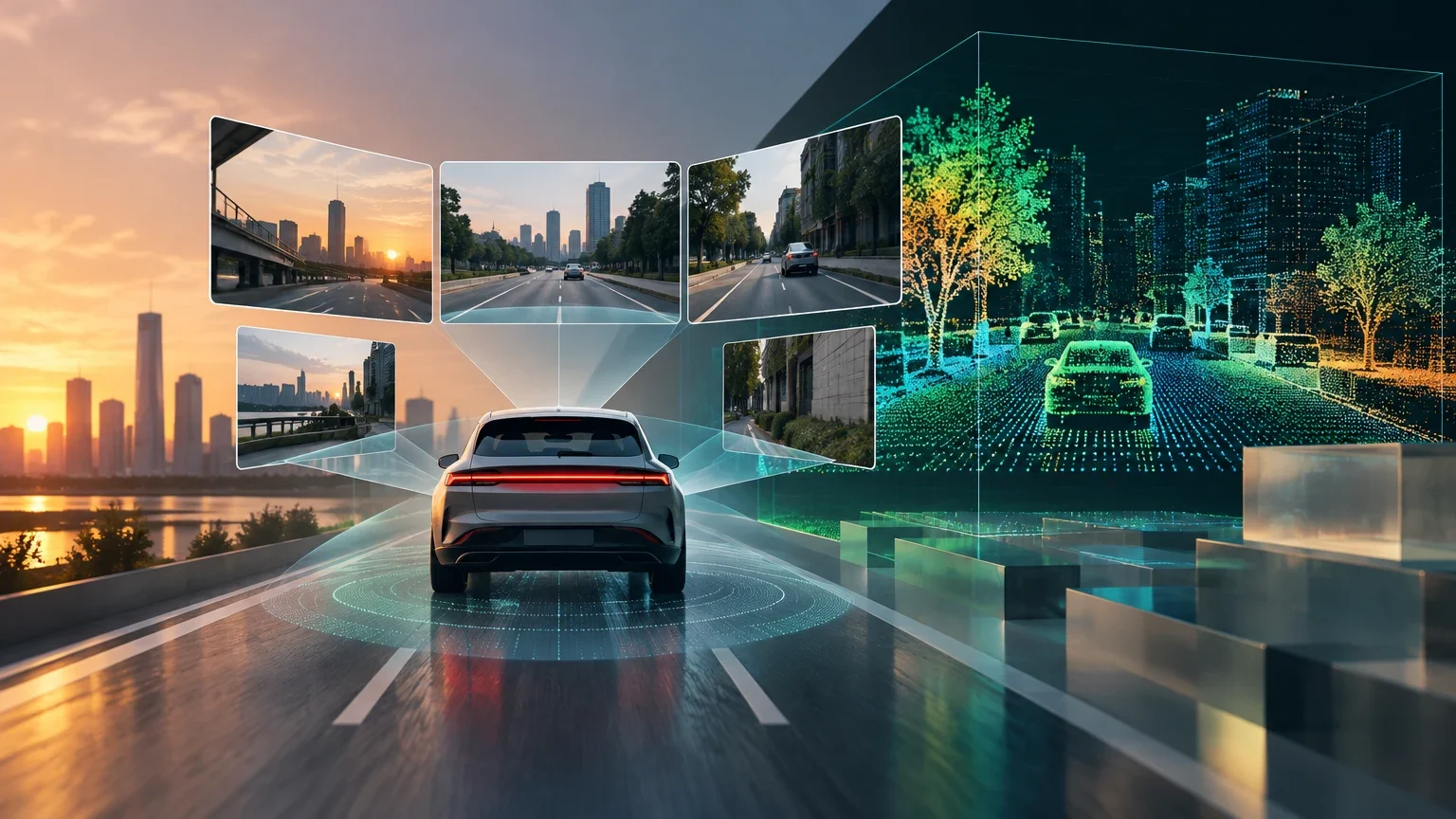
Cosmos3-Nano-Transfer-Auto is a specific variant of NVIDIA's Cosmos 3 family, designed for the generation of driving scenes using synchronized multiview video and LiDAR. Unlike causal simulation models such as Sim-Auto, this variant operates bidirectionally, positioning it as a batch generation tool for synthetic data creation and policy evaluation, rather than a real-time simulator.
The model accepts text, World State Map (WSM) controls, and an optional initial image as input. Its outputs include video from up to 11 cameras (standard or fisheye) and LiDAR data, with a resolution of 480p or 720p and up to 300 frames per view. This configuration distinguishes it from other Cosmos3-Nano variants, which focus on general robotics or creative video generation.
The bidirectional nature of the model describes how it generates a sequence from available context, rather than providing an exact representation of all physical causes within a scene. Its primary function is to produce audiovisual driving sequences for subsequent processing. Consequently, batch generation and real-time causal simulation serve distinct objectives: the former creates synthetic material that can later be reviewed, while the latter is used to update a simulation state as an interaction progresses.
World State Map controls allow specifying scene aspects alongside text and, optionally, an initial image. This combination offers different pathways to guide generation but does not convert each control into a deterministic guarantee that all elements will appear exactly as described. The optional image functions as a visual starting point; the outputs remain generated results that require inspection before being treated as suitable data for a specific use.
The limit of 11 cameras refers to the number of views the described configuration can produce, while the 300 frames correspond to the maximum indicated per view. This does not mean that all configurations must always generate the maximum number of cameras or frames. The available resolution, 480p or 720p, is also part of the output conditions and must be considered when evaluating whether the visual detail serves the intended analysis. The LiDAR output adds a distinct representation of the scene, but its presence alone does not demonstrate that every point is perfectly aligned with the video.
The Mixture-of-Transformers architecture and the 16B parameter size characterize the model, but they are insufficient to infer its speed, the cost of each batch, or the quality of a specific scene. Those results depend on the configuration and the execution infrastructure. The distinction from other Cosmos3-Nano variants is also important: the capabilities described here correspond to Transfer-Auto and should not be automatically transferred to variants oriented toward general robotics or creative video generation.
Key Specifications of Cosmos3-Nano-Transfer-Auto
The technical characteristics of Cosmos3-Nano-Transfer-Auto are documented in the official model card.
| Feature | Detail |
|---|---|
| Architecture | Bidirectional (Mixture-of-Transformers) |
| Parameters | 16B |
| Inputs | Text, WSM, optional image |
| Outputs | Multiview video (up to 11 cameras), LiDAR |
| Resolution | 480p or 720p |
| Max. frames | 300 per view |
Capabilities and Task-Specific Examples
The primary application of this model is the generation of synthetic data for training autonomous driving systems. By allowing the simultaneous generation of video from multiple perspectives and coherent LiDAR signals, teams can create edge-case scenarios that would be costly or dangerous to capture in the real world.
A practical example is the generation of scenes with adverse weather conditions or dense traffic, where the model can vary input parameters to produce controlled variations. Another use case is the evaluation of driving policies: by generating a synthetic environment, the response of an AI agent to specific situations can be tested without physical risk.
The utility of synthetic data lies in expanding the variety of available scenes, not in replacing real-world observations without evaluation. A generated scene can serve to examine how a perception system or policy responds to a chosen combination of conditions, but the outcome depends on the generation representing the elements to be studied in a pertinent manner. The presence of multiple views and LiDAR facilitates working with more than one modality; it does not guarantee that both modalities are coherent in all frames.
Adverse weather conditions and dense traffic illustrate variations that can be defined through input parameters. The ability to request controlled variations means teams can orient generation toward specific aspects; it does not imply that each change produces an isolated variation or that other details remain invariant. It is advisable to check the outputs and separate scenes that meet the set criteria from those containing artifacts or that do not usefully represent the requested condition.
In policy evaluation, the synthetic environment allows observing a generated response for a specified situation without physically exposing a vehicle to that situation. This advantage reduces physical risk during the synthetic test, but it does not demonstrate that the observed response will repeat in a real scene or that the policy is safe. The evaluation retains value as part of a broader process, provided its conclusions are limited to the scenario and the outputs actually examined.
The example of an intersection with pedestrians describes a possible configuration: text to specify geometry and the presence of people, WSM controls to orient the spatial state, and an output of up to 300 frames from six cameras, accompanied by LiDAR. The number of cameras in this example is lower than the maximum described for the model. The indication of spatial consistency expresses the purpose of WSM controls, not a guarantee of perfect alignment. Before incorporating the set into training, teams would have to verify that the generated people, geometry, and signals are pertinent and usable for the intended task.
Published Benchmarks and Methodology
NVIDIA has published performance metrics for this variant in its official card. The benchmarks focus on video generation quality (FID and FVD-I3D) for text-to-video (T2V) and image-to-video (I2V) tasks in the driving domain, using a guidance factor (CFG) of 3.
It is crucial to understand that these metrics measure the perceptual similarity and temporal consistency of the generated outputs, not road safety or absolute physical accuracy. The values are provided by the provider and have not been independently reproduced by Inferama. Furthermore, comparisons with other versions of Cosmos must be made with caution, as evaluation conditions may vary.
FID and FVD-I3D summarize different aspects of the evaluated output: FID compares image features to estimate perceptual similarity, while FVD-I3D applies to video sequences and reflects differences in spatio-temporal features. In both cases, a figure summarizes an evaluation defined by a methodology and a dataset; it does not constitute a direct measurement of driving capability, policy safety, or the physical accuracy of represented objects.
The table reports separate results for text-to-video and image-to-video generation, both with CFG3. The figures should not be read as a universal scale that allows comparing different tasks, configurations, or models evaluated with other procedures without further qualification. Although the table indicates that a lower value is better, this rule only guides interpretation within the corresponding metric and protocol; it does not mean that the system with the lower figure is necessarily safer or more useful in any application.
The CFG factor is part of the generation configuration evaluated. Therefore, the published results describe that specific condition and do not establish that other guidance intensities produce the same values. The metrics also do not eliminate variability between scenes or replace the review of individual outputs when coherence between views or correspondence with LiDAR is important.
The provenance of the values matters when using them: NVIDIA presents them as results of its own evaluation, and the text does not consider them independently verified. A subsequent comparison would have to maintain the same tasks, configurations, and measurement criteria for the observed difference to be interpreted meaningfully. When those elements change, the figures can orient an initial reading, but they do not allow attributing a general advantage to a variant on their own.
Performance Metrics Published by NVIDIA
FID and FVD-I3D values for the Transfer-Auto variant. Lower is better.
| Task | Metric | Value |
|---|---|---|
| Driving T2V (CFG3) | FID | 45.5 |
| Driving T2V (CFG3) | FVD-I3D | 488 |
| Driving I2V (CFG3) | FID | 27.8 |
| Driving I2V (CFG3) | FVD-I3D | 238 |
Pricing and Deployment Requirements
Cosmos3-Nano-Transfer-Auto is distributed as a public checkpoint under the OpenMDW 1.1 license, which permits commercial use. However, there is no official API fee published by NVIDIA for this specific variant; the cost is directly associated with the GPU infrastructure required to run the model.
Given that it is a 16B parameter model, the hardware requirements are significant. NVIDIA's documentation suggests that Nano variants can run on workstation or data center hardware, such as the RTX PRO 6000, H100, or B200. The actual cost will depend on the cloud provider or own hardware, including VRAM memory, bandwidth, and generation time, which is not real-time.
The absence of a published API fee for this variant means there is no official price per request or per unit of generation that can be used as a direct reference. The cost of use shifts to the execution of the checkpoint and, therefore, depends on the available hardware and how it is contracted or managed. The availability of the model as a public checkpoint does not equate to a hosted service nor does it establish by itself the cost of operating that service.
The names RTX PRO 6000, H100, and B200 appear as examples of hardware on which Nano variants can run according to the documentation cited in the text. It does not follow from this that all those devices have the same performance, that each configuration runs the model with identical capabilities, or that any of them guarantees a specific generation time. To estimate a batch, teams must consider the necessary memory, bandwidth, and compute time of their specific configuration.
The approximate storage of 32 GB mentioned in the note corresponds to the weights that must be saved, not to a complete estimate of the resources required during execution. VRAM memory, space for other process components, and the duration of generation can also influence the viability of deployment. Thus, the size of the weight file is not sufficient to decide whether a specific machine can run the intended workflow.
The GPU contracting modality can change the budget: on-demand rental and spot capacity do not necessarily have the same price or availability. Since NVIDIA does not publish a unified fee per minute of video for this variant, it is not possible to deduce an exact cost per minute from the model specifications. An economic comparison with real data capture must be based on local infrastructure costs and the volume of generation intended to be produced, without assuming a standard figure.
Limitations, Safety, and Alternatives
The model is not a certified physics simulator. NVIDIA's documentation explicitly warns that outputs may contain temporal inconsistencies, unstable motion, and imprecise physical interactions. Therefore, it should not be used as the sole source of truth for safety validation in critical systems.
Key limitations include quality degradation outside the training distribution and the need for independent validation for safety applications. As alternatives, teams may consider other video generation models for driving or traditional physics simulators (such as Isaac Sim) for tasks requiring strict physical accuracy, using Cosmos3-Nano-Transfer-Auto as a complement for data diversity.
The warnings about temporal inconsistencies, unstable motion, and imprecise physical interactions delimit the use of the model: a visually plausible sequence may not reliably respect the dynamics of a situation. Therefore, generation serves to expand or explore synthetic data, but it does not certify that a maneuver, distance, or interaction is physically correct. The validation of critical systems requires additional methods and should not depend solely on the model's outputs.
Degradation outside the training distribution indicates that behavior may be less reliable for scenes that differ from patterns represented during training. It does not allow anticipating in advance which specific scenes will fail, but it advises inspecting with special care generations that deviate from usual conditions. Quality review can detect some visible problems; it does not certify by itself that all relevant properties are correct.
Quality and temporal consistency filters, alignment metrics between LiDAR and video, and subsequent tests form complementary stages, not automatic guarantees. A filter can discard results that fail defined criteria, but its scope depends on those criteria. Similarly, measuring alignment between modalities does not demonstrate global physical accuracy. The proposed validation sequence should be understood as a process of checks that adjusts to the objective, not as a certification provided by the model.
Isaac Sim appears as an alternative for tasks requiring strict physical accuracy, while other video generation models for driving can serve different generation objectives. The comparison does not imply that one tool completely replaces another: Cosmos3-Nano-Transfer-Auto can provide synthetic diversity and a physics simulator can address different needs. The selection depends on which property needs to be evaluated and what additional validation is applied before using the results in a safety system.
Recommended Validation Flow
Suggested process for integrating synthetic data from Cosmos into a safety pipeline.
- 01Generate batches of synthetic scenes with Cosmos3-Nano-Transfer-Auto.
- 02Apply quality and temporal consistency filters to the outputs.
- 03Validate LiDAR-video coherence using alignment metrics.
- 04Train or evaluate the driving model with the synthetic data.
- 05Perform safety tests in the real world or high-fidelity physics simulators.
Practical Selection Criteria
The decision to use Cosmos3-Nano-Transfer-Auto should be based on the need to generate multiview and LiDAR data quickly and scalably. If the goal is real-time simulation for control, this model is not suitable; a causal simulator is recommended. If the goal is expanding datasets for perception training, it is a powerful tool.
Teams must evaluate whether their current infrastructure supports the VRAM requirements and whether the batch generation cost is viable compared to real data capture. Additionally, it is fundamental to review the OpenMDW 1.1 license and ensure compliance with attribution and usage terms.
The practical choice begins by distinguishing between expanding a dataset and executing a simulation that updates an agent's state in real time. Cosmos3-Nano-Transfer-Auto is oriented toward batch generation of multiview and LiDAR data; this orientation can be useful for expanding perception training material, but it does not make it an appropriate option for real-time control. When causal interaction and continuous updating are requirements, the text recommends considering a causal simulator.
GPU availability must be evaluated alongside the intended volume of generation, VRAM memory, and compute time. Having access to an H100 or B200 can make a test viable, but it does not allow concluding in advance that the total cost will be lower than capturing real data. The comparison requires estimating batch generation needs and own infrastructure costs, since there is no official per-token fee for this variant.
The OpenMDW 1.1 license permits commercial use according to the model description, but teams still have to review its terms and attend to the attribution and usage obligations that apply. Commercial authorization does not eliminate those conditions nor does it resolve by itself other requirements applicable to the dataset or deployment. The technical decision and license review are distinct checks, and both must be completed before adopting the model in a workflow.
The decision table should be read as a conditional orientation, not as a universal verdict. A high priority for multiview synthetic data favors considering the model; a need for real-time simulation points to another class of tool. GPU availability can change economic viability, but it does not determine the quality of the scenes. In particular, use in critical systems without validation is not recommended: synthetic generation can be part of the process, provided the outputs and the system undergo adequate independent validations.
Decision Table: Use Cosmos3-Nano-Transfer-Auto?
Criteria to evaluate the model's suitability.
| Criterion | Yes | No |
|---|---|---|
| Need for multiview synthetic data | High priority | Low priority |
| Real-time simulation requirement | Not suitable | Suitable |
| Availability of H100/B200 GPU | Viable | Prohibitive cost |
| Use in critical safety systems without validation | Not recommended | Recommended with validation |
Keep exploring
Sources consulted
Corrections and transparency
If you spot incorrect or outdated information, send us a correction with the page and source we should review.
Submit a correction